
Creatures of Air?
Deborah Colvin invites us to pause and reflect that we live immersed in what we scarcely notice: air, our unseen ocean.
One day an old and wise fish is swimming along when she meets a couple of young fish coming the other way. The elder fish calls out ‘Morning! How’s the water down your way?’ The young ones greet the elder respectfully, ‘Morning, yes, great thanks!’. When they are out of earshot they turn to each other and ask ‘What the &?@#! is water?’.
Our fishy teachers in the story show that to become aware of the nature of the medium in which we live, we need to develop some consciousness. Medium is so complete and pervasive we can’t imagine being outside it. We approach it remotely, descriptively via its effects. Chatting about the weather, the oldest social glue in the book, is indirectly commenting on our medium. Unless we strap on some big tanks and go underwater or into space it’s very difficult for us to have access to air-as-medium except from a subjective perspective of embeddedness within it. Fish can’t pop out onto the beach and describe the sea without dying in the attempt.
As landlubbers, we are ‘pneumatic fish’, belonging to and in some sense described by, the air. The atmosphere is our medium, our most intimate connection with the world around us. We swim in it, both inside and outside our bodies, our lungs never ceasing their rhythmic swell and ebb, 12 to 20 times every minute of our lives. Air is gaseous inside our lung spaces before it dissolves or is chemically bound in our blood. Sophisticated boundary mechanisms manage these transformations deep in the lungs, mirroring fishy gills continually interacting with water to extract gases. Where outside medium ends and inside begins is not straightforward. For divers with ‘the bends’, pressure changes can cause those dissolved gases to come out of solution and, unhelpfully for the diver, form bubbles on the inside. We are porous to medium, continuous with environment. As Mary Frohlich puts it, ‘A body is … not a self-generated individual emerging simply from its own interiority; the body is a relational event, is relationship itself, with no rigid boundary absolutely separating one from another.’
What exactly is air?
A clue is in the ‘exactly’ – it’s not exactly anything. By one definition it’s a mixture, meaning the composition can vary. We are conditioned to think that as animals we ‘breathe in oxygen and breathe out carbon dioxide’, defining air in an entirely utilitarian way that focuses on what we can get out of it. A product of our heroic, individualistic narratives. More ‘ecologically’, we could say that each inbreath contains 79% nitrogen, 20% oxygen, 1% argon and some traces of other stuff including carbon dioxide; and each outbreath contains 79% nitrogen, 16% oxygen, 1% argon and 4% carbon dioxide. We experience some very weird effects if the percentage of oxygen or carbon dioxide deviates from the narrow range we millions of years of evolution have fine-tuned us to. And then there’s the variable quantity of water vapour flowing in and out with every breath, depending on whether we’re in the shower, the desert or somewhere in between. Perhaps we should say we breathe a stream of nitrogen which is carrying a few other gases and tempered with steam.
Carrier, matrix, medium. It seems very hard for us to consider these environmental contexts as important or integral to a system, we love to extract and focus on ‘active ingredients’.
A classic example is ‘junk’ DNA. Thankfully this highly disrespectful term has thankfully been superseded and replaced with the word ‘intron’, which essentially refers to the vast majority of DNA that is non-coding, i.e. doesn’t provide a template for a protein that produces a characteristic in a living thing. So what’s it DOING taking up all that space in cells?
And what’s that vast reservoir of inert nitrogen DOING in the atmosphere? Maybe we need a different question.
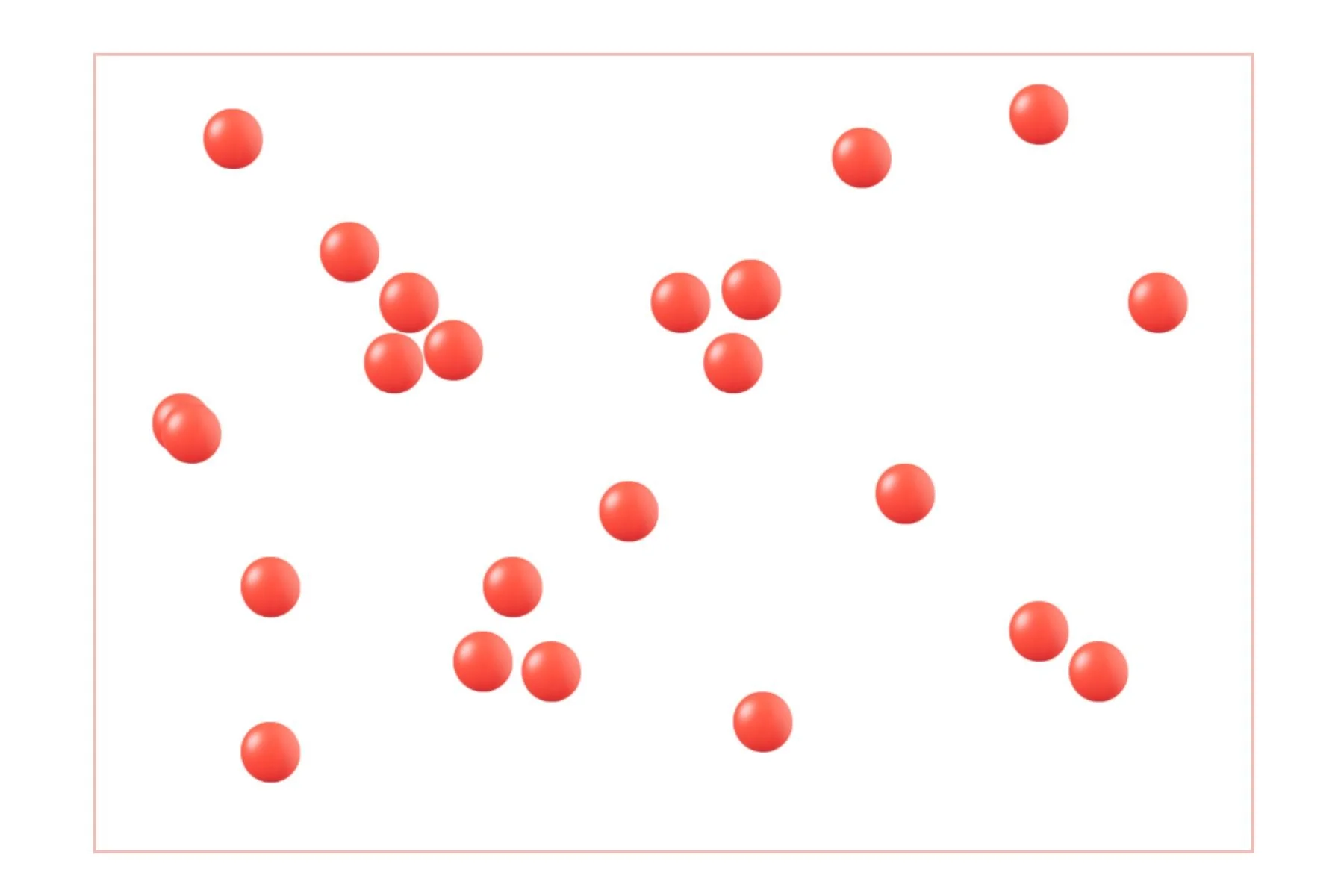
A classic trope for cajoling children into accepting that air consists of lots of particles with big gaps between them is to offer them a ‘box of air’ diagram like this one, explain that the dots represent molecules of gases, then get them to think about what’s between the molecules. Whereupon many fall into the elephant trap set for them and say ‘air’. The task then becomes thinking about empty space (which is not nothing in itself, and also includes sub-atomic particles whizzing about in the gaps). Perhaps we are vacuum-beings rather than pneumatic beings as there is much more ‘empty’ space in our primary medium than anything else.
Nevertheless, this particular model is an excellent explanatory one that has served us well for a couple of hundred years, ever since John Dalton, growing his scientific mind in Manchester just before the industrial revolution, first proposed his atomic theory. Dalton’s family were Dissenters – Quakers - so John was not permitted to attend university at the end of the 18th century, and was therefore able to freely think outside the box…
Ideas from inside the box persist when scientific thinking is evolving and it’s not always helpful to simply dismiss them. Dialogue between models is sometimes as fruitful as Copernican revolutions, and there’s nothing like a dose of cognitive dissonance to deepen reflection.
Prior to Dalton’s era, the classical elements of earth, air, water and fire were very much inside the acceptable thinking box for many and diverse cultures - according to Wikipedia these included Greece, Angola, Tibet, India and Mali. These four elements provided a strong framework for understanding the world, sometimes with the addition of ‘aether’ which served a multitude of roles: accounting for empty space, vibrating to generate light, and making space for a spiritual dimension. The four elements patterning in our minds continues in parallel and interaction with atomic theory.
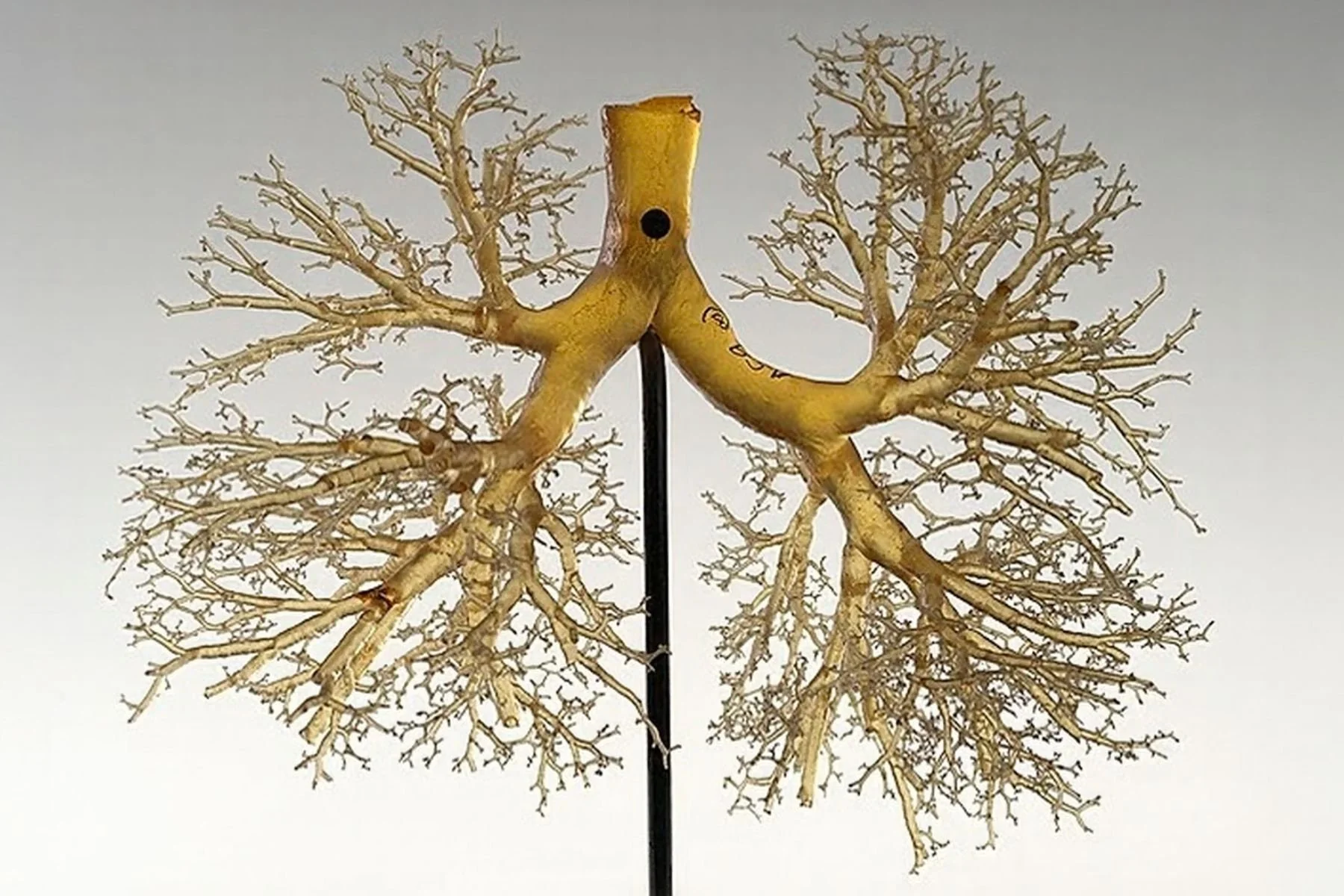
Back to those boundary mechanisms. Lungs are like huge leaky parachutes, folded, folded and folded again in order to fit a very thin membrane the size of half a tennis court into a human thorax. The macro-impression is astonishingly tree-like. Branching is integral to multi-cellular life.
The alveoli which do the actual gas exchange are tiny sacs, looking like bunches of grapes in the textbooks, dangling at the ends of the fantastical tubular network that channels air downwards and inwards. The word alveolus is Latin for a small cavity, basin or hollow. It’s the diminutive of alvus, a basin, belly, womb or other cavity, and also the hold of a ship. So a little space for holding substance of great value, like cupped hands.
Each alveolus is more-or-less spherical, the geometric shape that maximizes surface area for an enclosed volume, prioritising edges rather than the container itself. Their enclosing membranes are one flattened cell thick and always wet, the better to dissolve gases and channel them from the airy lung spaces (or better, ‘steamy’ as its very humid in there) to the capillary net on the inside.
We are closer to our fishy ancestors than we think – at all the surfaces where we are most intimately in contact with our outside medium, water washes over our cells, caressing, supplying and cleaning them. We are still aquatic beings after all, the ocean travels with us: our guts contain oceans of micro-organisms; an amniotic sac is an ocean-bearing cradle; our eyes are small, crystal-clear oceans; blood is a river of ocean; and every tiny cell is a droplet of ocean in itself.
Once the air is carefully managed across the alveolar membranes, oxygen is delivered to every cell in our bodies and carbon dioxide is efficiently removed. Every single one of billions of cells over a 2-meter body length and 20cm depth of tissue! Whether they are muscle cells lodged in a middle toe, white blood cells on the move in and out of capillaries, or β cells in the pancreatic Islets of Langerhans pumping out insulin, every single cell gets what it needs to fulfil its vocation. What a model of welfare and economic flourishing: to each according to their needs, from each according to their gifts.
Breathe in, breathe out… otherwise known as Praise Be!
Explore more from Breathe Project
Collaborate with us
We're always open to new collaborations and creative partnerships that blend art, science and faith and community involvement to think differently about Earth Justice.
Explore All Our Projects
Nulla id congue ligula, pharetra venenatis massa. Aliquam in tellus varius, lacinia lorem ac, venenatis nunc. Donec neque nulla, convallis vel justo vitae, convallis imperdiet diam. Aliquam erat volutpat.