
The Air We Breathe is an Earth Justice matter
Penelope Turton explores how clean, safe air is a fundamental human right and the complex, interconnected issues that surround air pollution.
Air is the primary medium in which we live and move and have our being. The newborn baby’s first gasping, spluttering breath signals she is alive in the world. It is through air that we savour the scents of the natural world, feel the warmth of the sun and the freshness of the breeze and sense the shifts in the weather and the season. With every breath we take and release we are in direct relationship with the ecosystem that sustains us. And “as we come to breathe our last” we die.
Air is fundamental to all life on planet earth, a sacred gift freely imparted. The right to breathe safe air is now recognised by the UN Security Council. But it has become increasingly threatened in the current Anthropocene epoch, now well advanced, which has brought pollution and climate breakdown to levels that endanger the health and well-being of the entire ecosystem. The World Health Organisation assesses that almost the entire global population (99%) breathes air that exceeds safe air quality limits.
Pollution
Pollution is the largest environmental cause of avoidable disease, disability and premature death in the world today1. Air pollution is responsible for almost 75% of the 9 million pollution deaths globally each year2 with many millions more suffering from poor health. The death toll dwarfs that from road traffic deaths, HIV/Aids, malaria and TB combined, or from drug and alcohol misuse. The research data are complex and can appear contradictory. They must take account of both household (indoor) and ambient (outdoor) pollution and multiple sources of both anthropogenic and natural pollution, many of which interact and overlap and are changing rapidly over time and space. In most developed countries pollution is declining due to the ramping up of clean energy and legal frameworks restricting emissions. In lower-income countries, whose economies have more recently been growing on the back of the fossil fuel energy sources that have already made developed countries so rich, they are rising. The overall trend is still upwards, mainly because of population growth and rapid industrialisation of low- and middle-income countries. For example, the area of land allocated to oil and gas production on the African continent is set to quadruple. Many of these exploration sites threaten 30% of dense tropical forests in Africa3.
The WHO estimates that in 2019, some 68% of ambient air pollution-related deaths were due to ischaemic heart disease and stroke, 14% to chronic obstructive pulmonary disease, 14% to acute lower respiratory infections, and 4% to lung cancers4. In addition to the health burden of ambient pollution, around 2.1 billion people worldwide (around a third of the global population) cook using open fires or inefficient stoves fuelled by kerosene, biomass (wood, animal dung and crop waste) and coal, which generates harmful household air pollution. More recent studies tend to find a higher death toll than earlier studies because new scientific evidence suggest that the health impacts of exposure to pollution are larger than previously thought. (For links to more information on different pollutants, their sources and their particular impact on human health, see Appendix below).

Buildings are seen shrouded in smog in Jakarta, Indonesia on November 9, 2023. Millions of residents of Jakarta have for the past several months suffered from some of the worst air pollution in the world. Mandatory Credit: Photo by Aji Styawan / Climate Visuals.
How has this come about?
The main cause of air pollution is the combustion of fossil fuels. This accounts for 85% of fine particulate air pollution and for almost all airborne emissions of sulphur oxides and nitrogen oxides. Fossil fuel combustion is also the major source of the greenhouse gases such as carbon dioxide and the short-lived climate pollutants that are the major drivers of climate change1. Behind this global public health crisis lies an economic model that fails to link development to social or economic justice or to stewardship of the planet. It is beyond the scope of this paper to discuss how the devastation of the earth’s ecosystems is attributable to the worldwide obsession with economic growth in Gross Domestic Product (GDP), due to its tight coupling with burning fossil fuels. (A paper exploring ways in which societies might bring about a just transition to sustainable economic growth is referenced below 5).
Multiple Injustices
For too long wealthy nations have plundered the earth’s natural and human resources through over-extraction, hyper-consumption and exploitation. At the other end of their operations, negative ‘externalities’ such as unwanted wastes are released into the environment by producers who have taken no responsibility or shown any concern for how, where or whom they may harm - let alone shown willing to take remedial or mitigating measures, including compensation for the damage caused.
Just as the benefits of the rich industrialised nations’ economic development have been inequitably distributed, both within or beyond their boundaries, so the impacts of environmental degradation, pollution and climate change have also not been evenly distributed. They fall disproportionately heavily on countries who have done least to cause them. Approximately 89% of premature deaths occur in low- and middle-income countries, the heaviest toll being borne in the WHO regions of South-East Asia and Western Pacific. Marginalised and disenfranchised communities and the indigenous peoples around the world are particularly affected. Often the most vulnerable groups are located near industrial plants, factories, roads and landfills, areas where pollution levels tend to be higher. Women and children, typically responsible for household chores such as cooking and collecting firewood, bear the greatest health burden from the use of polluting fuels and technologies in homes. Household air pollution led to an estimated 3.2 million deaths in 2020 6. The scarcity of access to political power of poorer communities limits their ability to demand better environmental quality. Prioritising economic interests over public health in many government policies perpetuates and even increases inequalities.
The role of colonialism in the present crisis should also be recognised. During colonial rule, European powers extracted valuable resources from African nations without regard for their long-term economic development. Colonialists saw “new” territories as places with unlimited resources to exploit in the service of early modern state-making and capitalist development. For example, British colonial rulers in Nigeria focused on extracting oil, positioning Nigeria as one of Africa’s major oil producers. Nigeria’s economy remains heavily reliant on oil exports and faces the consequences of price fluctuations in global markets. The UN Development Programme has documented the economic instability that accompanies raw material dependency, noting that countries lacking the infrastructure to process their resources into higher-value products struggle with poverty and limited economic diversification 3. Approximately 40% of Nigerians live below the national poverty line.
Other African governments point to the double standards of countries in the global north that have grown rich on the back of fossil fuel development, whose per capita emissions far outstrip that of developing nations and who continue to expand their own fossil fuel operations – while seeking to dial back their financing of fossil fuels in developing countries.
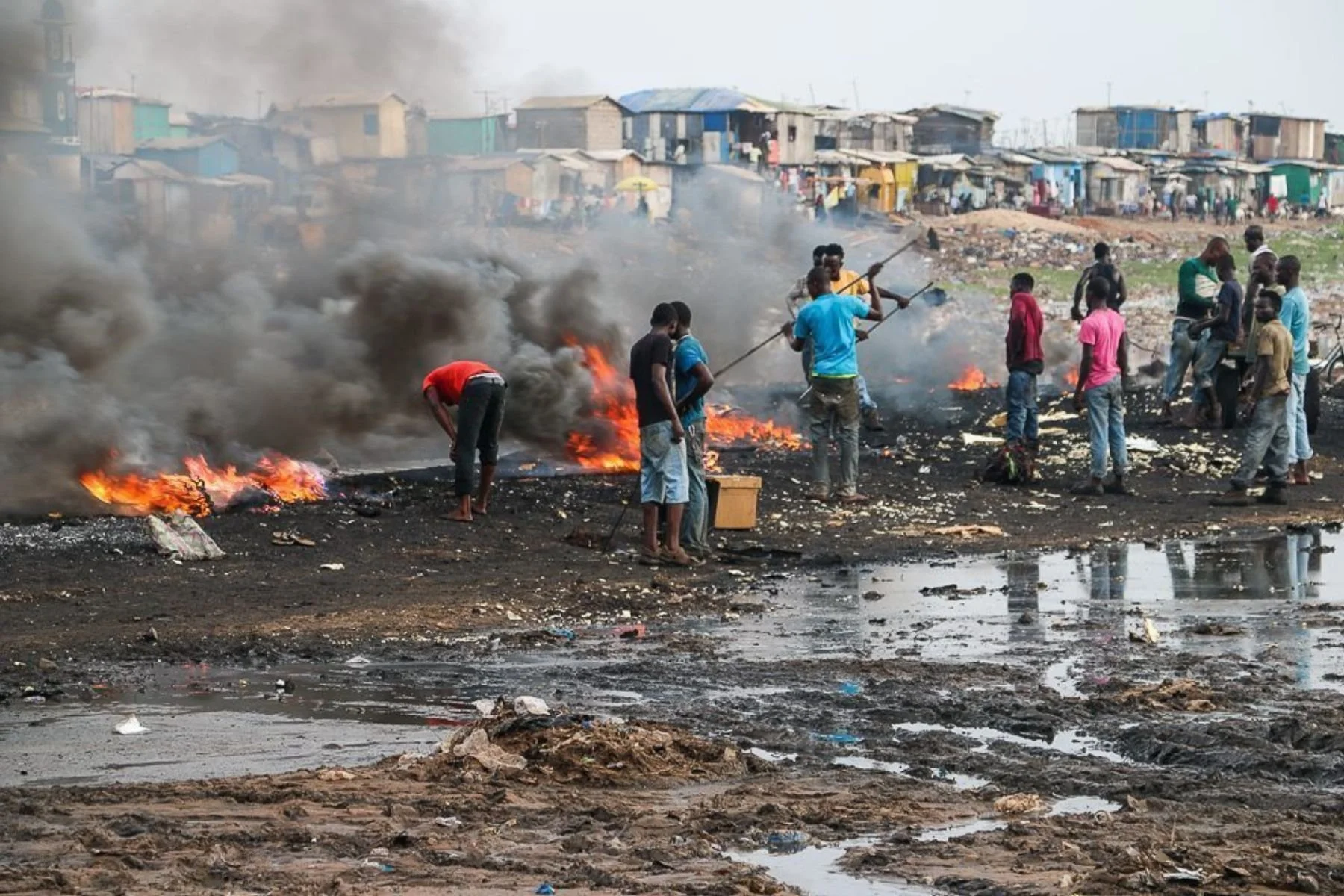
In Agbogbloshie, suburb of Accra in Ghana, is an informal dumping ground for electronic waste such as mobile phones. Often this waste is illegally imported from industrialized nations. Mandatory credit: Fairphone, via the Climate Visuals website.
How can environmental justice be promoted?
Since the 1990s, governments have been enacting legislation imposing the cost of externalities on the producer. The right to a sustainable and healthy environment was acknowledged by the United Nations Human Rights Council in October 2021 and subsequently by the UN General Assembly in 2022. However, the steady stream of court cases brought by indigenous communities and environmental defenders is evidence of how far these rights are from this being universally accepted and practiced. At successive climate COPs, rich countries, whose industrial economies have brought previously unimagined material riches, have resisted taking responsibility for the environmental impacts of their wealth.
It surely must be the responsibility of both governments and business organisations to implement policies of accountability, mitigation and reparation for harms done in the pursuit of profits and to adopt an inclusive culture of community participation in decisions that affect the lives of peoples in their zones of operation. And for all of us as individuals, to lobby for such change and to ensure that we are educated and vigilant about the pollution footprint of what we use and consume so that we reduce our own harms as far as possible. As Wendell Berry writes “The only questions we have a right to ask is what’s the right thing to do? What does the earth require of us if we want to continue to live on it?”
Christian teaching is very clear about the response that we must make. We cannot enjoy the spirituality that truly is of God unless we are engaged in the struggle for justice, love and compassion in the world. Matthew’s gospel is explicit – and it is exacting. Jesus tells his disciples that in failing to care for ‘the least of their brothers and sisters’, they are failing to care for Him. When we are in wrong relation with one another, with Creation and the Spirit that connects us, we separate ourselves from God and are effectively ‘broken’. It seems that we must do nothings less than die to the old life and be reborn in the new. Or as Joanna Macy puts it “Of all the dangers we face .. none is so great as the deadening of our response.. We are going to have to want different things, seek different pleasures, pursue different goals than those that have been driving us and our global economy.”
How are we to meet this challenge? How are we to ensure that our love for the God-given gift of Creation is activated to work for justice for all?
When we come to breathe our last… God have mercy.
Appendix
Notes on Pollution:
Particulate matter (PM) - is a common proxy indicator for air pollution. There is strong evidence for the negative health impacts associated with exposure to this pollutant. The major components of PM are sulphates, nitrates, ammonia, sodium chloride, black carbon, mineral dust and water.
Carbon monoxide (CO) - is a colourless, odourless and tasteless toxic gas produced by the incomplete combustion of carbonaceous fuels such as wood, petrol, charcoal, natural gas and kerosene.
Ozone (O3) - Ozone at ground level – not to be confused with the ozone layer in the upper atmosphere – is one of the major constituents of photochemical smog and it is formed through the reaction with gases in the presence of sunlight.
Nitrogen dioxide (NO2) - is a gas that is commonly released from the combustion of fuels in the transportation and industrial sectors.
Sulphur dioxide (SO2) - is a colourless gas with a sharp odour. It is producd from the burning of fossil fuels (coal and oil) and the smelting of mineral ores that contain sulphur.
Further information on the specific health impacts of particular pollutants can be found in the table here https://pmc.ncbi.nlm.nih.gov/articles/PMC10472068/table/tbl1/ and its paper here https://pmc.ncbi.nlm.nih.gov/articles/PMC10472068/
Explore more from Breathe Project
Collaborate With Us
We're always open to new ideas and creative partnerships that bring multiple perspectives into focus in the service of Earth Justice. Please get in touch.
Explore Our Projects
Explore our evolving archive of multi-disciplinary, collaborative projects. We value art, poetry, science, faith, history, community engagement and more, and the creative spaces that open up between them.