
Changing our Minds:
Learning to be Ecozoic
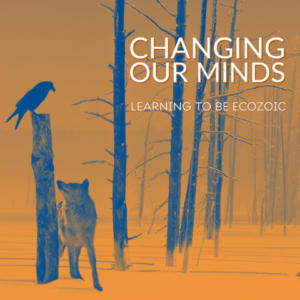
This series of online conversations emerged from our ‘Food for the Ecozoic’ project, a practical adventure in food-growing and a spiritual quest.
We are living in a polycrisis that threatens to overwhelm us. We need profound change in our understanding and behaviour if future generations are to have a liveable future. The ancient Greeks’ had a word for this kind of change: Metanoia, a transformative change of heart or spiritual conversion.
As a species we have a rich heritage of story, tradition, skills and wisdom to draw upon. Indigenous peoples, rooted in the Earth for tens of thousands of years, hold much of this heritage. But both indigenous peoples and the more-than-human world have suffered grievously from a colonising mindset that reduces the earth and its peoples to a collection of exploitable resources. Christianity has, sadly, played a significant role in this exploitative history.
A Season of Online Conversations
In these conversations, we invited voices from Turtle Island (the North American continent) to unsettle our assumptions, challenge our world-views and share their visions of mutuality between humans and with the more-than human world. Thanks to the generosity of our conversationalists these events were offered free of charge. Each session lasted about 75 minutes.
We asked:
What happens to our action in the world if we see each created being as alive, sentient and connected?
What does a decolonised and decolonising Christianity look like?
How would such a decolonising, rewilding paradigm shift affect our reading of Biblical and Foundational texts?
How can our highly diverse, urbanised and globalised societies ‘be more indigenous’ in the places we find ourselves in the 21st century?
Our Conversationalists
Conversations were hosted by Deborah Colvin, a member of the Earth Justice team at St James’s. Deborah is an educator and environmental activist, and was formerly a farmer and agricultural scientist. She was born when atmospheric carbon dioxide concentration was 318 parts per million. In 2023, carbon dioxide peaked at 424 parts per million.
In conversation with Rev Shawn Sanford Beck
Being amongst beings: the animate Earth
Shawn Sanford Beck is an ecumenical Christian priest in Saskatchewan, Canada and author of ‘Christian Animism’ .
He is the founder of the Ecumenical Companions of Sophia, an informal online community fostering Christian-Pagan dialogue and spiritual practice,who describe themselves as “a body of mutual support and encouragement, living as salt, light, and yeast in the midst of an ecocidal society.”
In conversation with Dr Lyla June Johnston, Diné Nation
Indigenous sciences of sustainability: ancient native food systems and their lessons for the future
Dr Lyla June Johnston (aka Lyla June) is an Indigenous musician, scholar, and community organizer of Diné (Navajo), Tsétsêhéstâhese (Cheyenne) and European lineages. Her messages focus on Indigenous rights, supporting youth, traditional land stewardship practices and healing inter-generational cultural trauma. Her doctoral research focused on the ways in which pre-colonial Indigenous Nations shaped large regions of Turtle Island (aka the Americas) to produce abundant food systems for humans and non-humans.
In conversation with Jim Perkinson and Lily Mendoza
Indigenous sacralities underneath state ideologies: reading the Bible, reading modernity
Jim is a long-time activist and educator in inner city Detroit. He is Professor of Social Ethics at the Ecumenical Theological Seminary and lecturer in Intercultural Communication Studies at the University of Oakland (Michigan).
Lily is Professor of Culture and Communication at Oakland University, Michigan, and Director of the Centre for Babaylan Studies, a non-profit organisation committed to decolonisation and indigenisation among diasporic Filipinos on Turtle Island.
In conversation with Sandy Bigtree, Mohawk Nation, and Prof Philip P. Arnold
Sandy Bigtree, Bear Clan, is a citizen of the Mohawk Nation at Akwesasne. She is a founding board member of the Indigenous Values Initiative which fosters collaborative educational work between the academic community and the Haudenosaunee to promote the message of peace that was brought to Onondaga Lake thousands of years ago.
Prof Philip P. Arnold is Associate Professor and Chair of the Department of Religion at Syracuse University, and a core faculty member of Native American and Indigenous Studies.
“That the universe is a communion of subjects rather than a collection of objects is a central commitment of the Ecozoic.”
Brian Swimme and Thomas Berry
Explore the ‘Changing our Minds’ Series
Collaborate With Us
We're always open to new ideas and creative partnerships that bring multiple perspectives into focus in the service of Earth Justice. Please get in touch.
Explore Our Projects
Explore our evolving archive of multi-disciplinary, collaborative projects. We value art, poetry, science, faith, history, community engagement and more, and the creative spaces that open up between them.