
Food for the Ecozoic: The Millet Garden
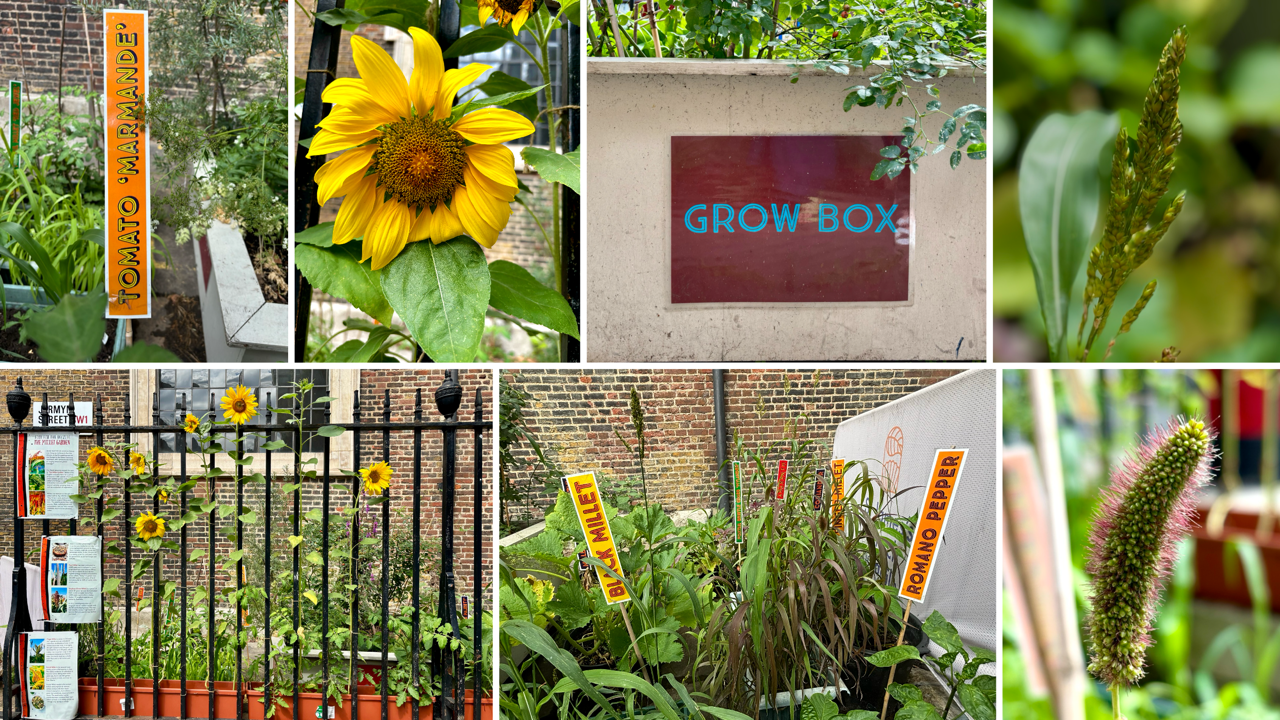
In 2024, we expanded our ‘Food for the Ecozoic’ project into the ‘Millet Garden’, which grew on the curtilage on the South side of St James, Piccadilly.
As we head into an uncertain future, one thing we do know is that the climate on Earth is getting warmer and Europe is the fastest-warming continent, with temperatures rising at roughly twice the global average.*
(*U.N.’s World Meteorological Organisation and the EU’s climate agency, Copernicus, joint report published in April 2024.)
What is Millet?
Millet is the English umbrella term for a group of around 1,500 species of annual small-seeded grasses cultivated as cereal and forage crops for human and animal consumption. There are several varieties growing here, as well as a selection of vegetables. It is a widely grown staple crop, it can be eaten boiled as porridge or a rice replacement, ground to make flour, in snacks, yoghurts, syrup and fermented drinks. In the USA and UK it is mainly grown for bird-seed, cover for game-birds, as animal forage and biofuels.
Types of Millet
Millet is the English umbrella term for a group of around 1,500 species of annual small-seeded grasses cultivated as cereal and forage crops for human and animal consumption. There are several varieties growing here, as well as a selection of vegetables. It is a widely grown staple crop, it can be eaten boiled as porridge or a rice replacement, ground to make flour, in snacks, yoghurts, syrup and fermented drinks. In the USA and UK it is mainly grown for bird-seed, cover for game-birds, as animal forage and biofuels.
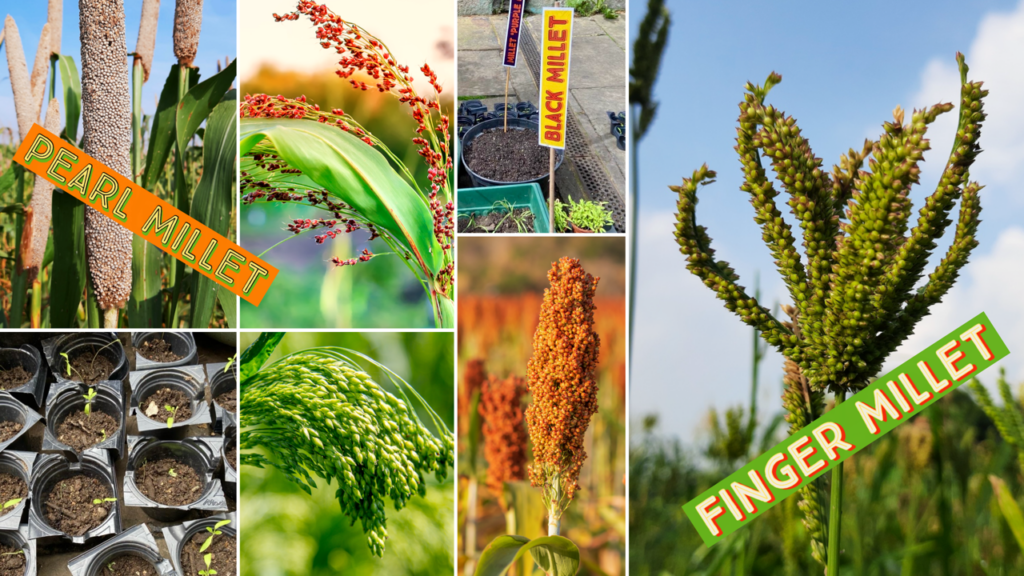
Pearl Millet
Pearl Millet has been cultivated for 4,000 years and is believed to have originated from sub-Saharan Africa. It is rich in vitamin B and has the highest energy content compared to other millets. Today it is grown over 260,000 square kilometres of land and accounts for 50% of world millet production.
Sorghum
Sorghum (Great Millet) is a genus of about 25 grass species domesticated from a wild ancestor more than 5,000 years ago in what is today Sudan. 17 sorghum species are native to Australia. In 2021, world production of sorghum was 61 million tonnes with the US as the lead grower. The red leaf-sheaths contain high levels of tannins that are used to dye leather and wool.
Finger Millet
Finger Millet is native to Ethiopia and Uganda and can withstand cultivation at altitudes of over 2,000 meters above sea level. It is highly drought resistant and the grain can be stored for up to 50 years, which makes it an important crop in risk- avoidance strategies as a famine crop. It is mainly used as a whole grain flour and is rich in iron and calcium.
Foxtail Millet
Foxtail Millet is the second-most widely grown millet species in Asia. The oldest evidence of cultivation is found in China dating from 8,000 years ago, but it was also grown from antiquity in India and later in East Siberia. Foxtail Millet needs to be soaked before consumption to remove certain compounds that block mineral absorption, but makes a good rice substitute, steamed and in soups. The seed colour varies greatly between varieties from light yellow to black. It is widely grown as a forage crop as hay or silage.
Explore our Food For the Ecozoic Project
Collaborate With Us
We're always open to new ideas and creative partnerships that bring multiple perspectives into focus in the service of Earth Justice. Please get in touch.
Explore Our Projects
Explore our evolving archive of multi-disciplinary, collaborative projects. We value art, poetry, science, faith, history, community engagement and more, and the creative spaces that open up between them.