
St Francis: Radical Kinship
Diane Pacitti celebrates St Francis, the saint who radically re-imagined our relationship with the earth and the cosmos. Our ‘Food for the Ecozoic’ project, explores our kinship with the more-than-human world and with fellow-humans. We do this in the context of the National Gallery exhibition St. Francis of Assisi and two related events taking place at St. James’s.
‘It was easy to love God in all that was beautiful. The lessons of deeper knowledge, though, instructed me to embrace God in all things.’
Attributed to St Francis of Assisi

In the early Church and through the Middle Ages, there was a belief that every created being could praise God in its own distinctive way. But there were strict hierarchies, laid out in a structure known as the Great Chain of Being. This Chain descended from God and the angels to humankind, then through the ranked animals, birds and fish down to plants and minerals. And there were hierarchies within the hierarchies. Just as the king was designated by God to rule other humans, so the lion was the highest among animals and the dolphin superior to all other fish.
And then, in the early thirteen century, a wandering friar challenges all that by saying ‘Sister Water’; ‘Brother Wolf’ . Instead of placing humankind on a God-ordained pinnacle above the rest of Creation, he is entering into a new relationship with the lives around him. To affirm kinship – motherhood, sisterhood, brotherhood – is to enter into new possibilities of mutuality, respect and love.
Francis affirmed this kinship in engaging and radical ways. His biographer Thomas de Celano gives an account of Francis interrupting his journey to preach to the birds, celebrating their distinctive avian qualities as he urged them to praise God. After this, he began to preach to animals, reptiles and ‘Insensible creatures’. Stories soon grew around this charismatic figure. In the National Gallery exhibition, a painting by Sassetta depicts his encounter with the wolf who had terrorised the town of Gubbio. The wolf is placing its right paw in the hand of the saint, who promises that the animal will be forgiven and fed by the townsfolk.

St. Francis (detail), by Margaritone d’Arezzo (1290).

The image is the oldest surviving depiction of St Francis is a fresco near the entrance of the Benedictine abbey of Subiaco, painted between 1228 -1229.
Recent science has taught us that the five of the six elements of our DNA (carbon, nitrogen, oxygen, nitrogen and phosphorus) are made by the stars and released into the cosmos when these stars collapse. We share 50% of our DNA with trees; 70% with slugs and 44 % with honeybees. We are indeed kin to the planets and all other inhabitants of this earth. Early peoples felt this kinship instinctively and recognised it in their rituals and stories. Francis of Assisi arrived at this insight through prayer and imaginative empathy. It is fascinating that mystics like Francis or Hildegarde of Bingen can sometimes be centuries ahead of the scientists.

St Francis and the Wolf by Michael Smither, (2007-2018)
It is easy to sentimentalise Francis’s love of birds and animals, and reduce him to what I heard described in a conference as ‘the bird-bath Francis.’ In fact, Francis experienced the earth in her iciest temperatures, her harshest conditions. Travelling through Italy in snow and gales, fasting and praying on the remote mountain peak of La Verna, sleeping on the floor of a small cave, he was finally racked by illness.
He is said to have composed the Canticle of the Creatures (better known as the Canticle of the Sun) while temporarily recovering from this illness, and to have added the verse about Sister Death when he was blind and close to death. It expresses a holistic faith that absolutely everything, whether gentle or threatening, emanates from the love of God.
St Francis and the Crib
The crib is such an essential part of our Christmas that it seems surprising that it did not exist before 1223, when Francis created a ‘living crib’ at the small Italian town of Greccio. Before that the celebration of Christmas belonged to the priests, who conducted a high Latin mass inside a church building.
In contrast, Francis reclaimed the birth of Christ for the original participants: poor people, animals, plants. He placed an ox and an ass round the manger; he imported hay, representing plants, and with his brothers he celebrated the Christmas mass with the local people, who streamed past the crib with lights and candles, creating the light of the star. At the end he insisted the hay and the animals should be taken care of because we must care for every created thing, even when we no longer need it.
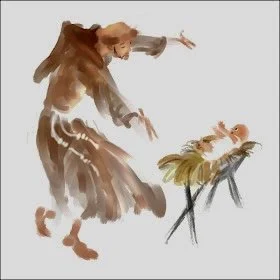
St Francis and the Crib, by J R Howley (2011)
Pope Francis
Pope Francis (the first Pope to choose that name) named his 2015 encyclical Laudate Si after Francis of Assisi’s ‘Canticle of the Creatures’. Subtitled ‘on care of our common home” this encyclical laments environmental degradation and global warming, calling on all people to take ‘swift and unified global action.’ Very much in the spirit of his medieval namesake, Pope Francis states that instead of viewing humanity as having ‘dominion’ over the earth, we must see that all of creation is a “kind of universal family’.
Francis of Assisi understood that indifference or cruelty to our fellow-creatures will soon develop into the abuse of other humans, saying ‘if you have men who will exclude any of God’s creatures from the shelter of compassion and pity, you will have men who will deal likewise with their fellow men.’ Similarly, Pope Francis has articulated the link between the degradation of the earth and the economic exploitation of poorer countries.
St Francis and the Sow
The bud
stands for all things,
even for those things that don’t flower,
for everything flowers, from within, of self-blessing;
though sometimes it is necessary
to reteach a thing its loveliness,
to put a hand on its brow
of the flower
and retell it in words and in touch
it is lovely
until it flowers again from within, of self-blessing;
as Saint Francis
put his hand on the creased forehead
of the sow, and told her in words and in touch
blessings of earth on the sow, and the sow
began remembering all down her thick length,
from the earthen snout all the way
through the fodder and slops to the spiritual curl of the tail,
from the hard spininess spiked out from the spine
down through the great broken heart
to the sheer blue milken dreaminess spurting and shuddering
from the fourteen teats into the fourteen mouths sucking and
blowing beneath them:
the long, perfect loveliness of sow.
Galway Kinnell (2002)
Explore Food For the Ecozoic
Collaborate With Us
We're always open to new ideas and creative partnerships that bring multiple perspectives into focus in the service of Earth Justice. Please get in touch.
Explore Our Projects
Explore our evolving archive of multi-disciplinary, collaborative projects. We value art, poetry, science, faith, history, community engagement and more, and the creative spaces that open up between them.