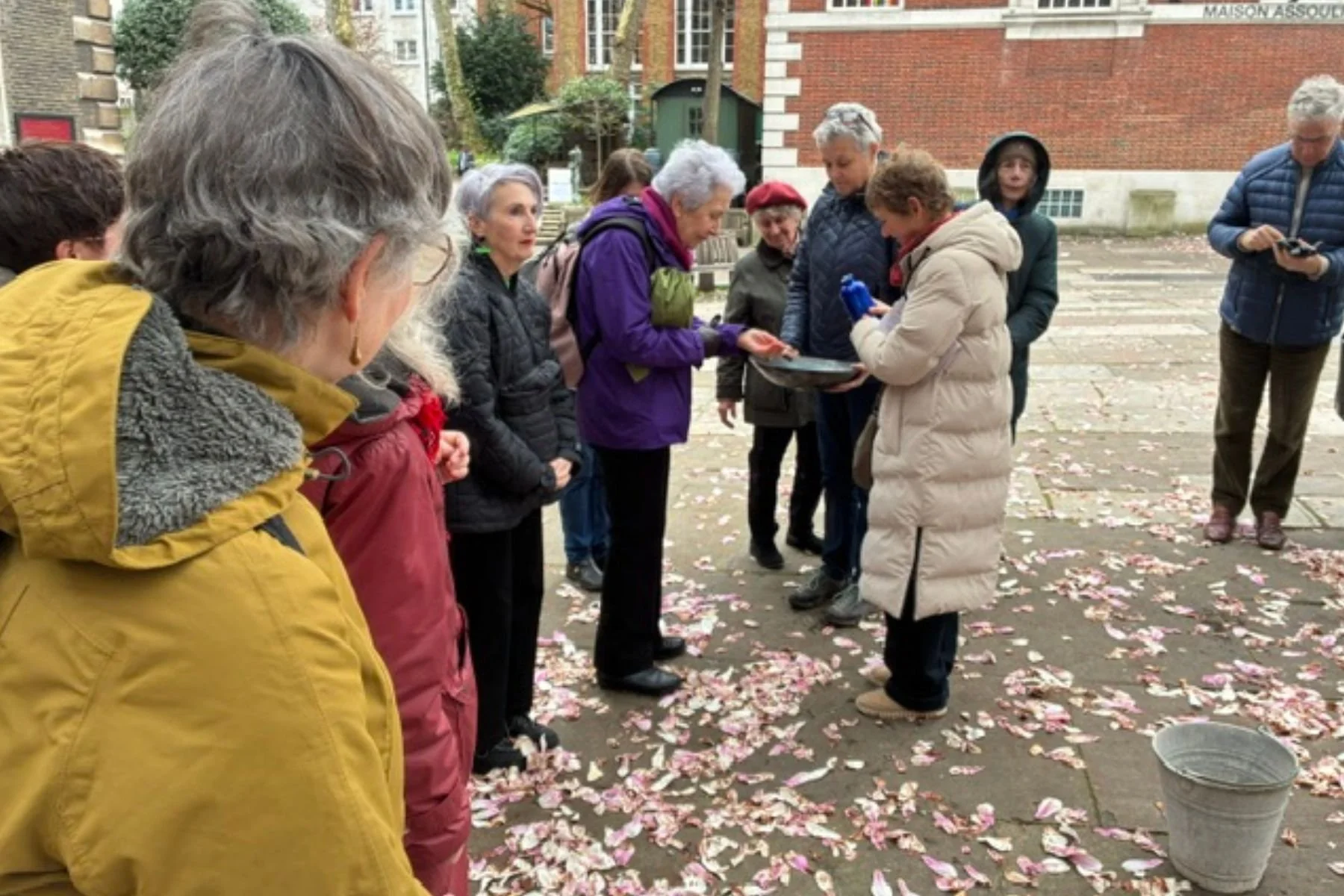
A Wellspring Pilgrimage, March 2026
Early in the 20th Century there were 10 wells listed in St James’s parish. Our pilgrimage takes us to the sites of these ten wells, although the wells themselves are no longer visible. We have no knowledge of their physical status under our streets in the early 21st Century. Perhaps they have collapsed and are full of sand and clay, perhaps they still contain columns of water, but their imprint remains and we celebrate their hidden connections to the land-and-water-scape below us, tunnelling like reverse-periscopes through the geology.
Our pilgrimage is a journey open to imagination, encounter and a sense of the sacred, especially the sacredness of rock and water beneath us. On the surface, we encounter ten locations and reflect on centuries of shifting human focus in relation to water and wells.
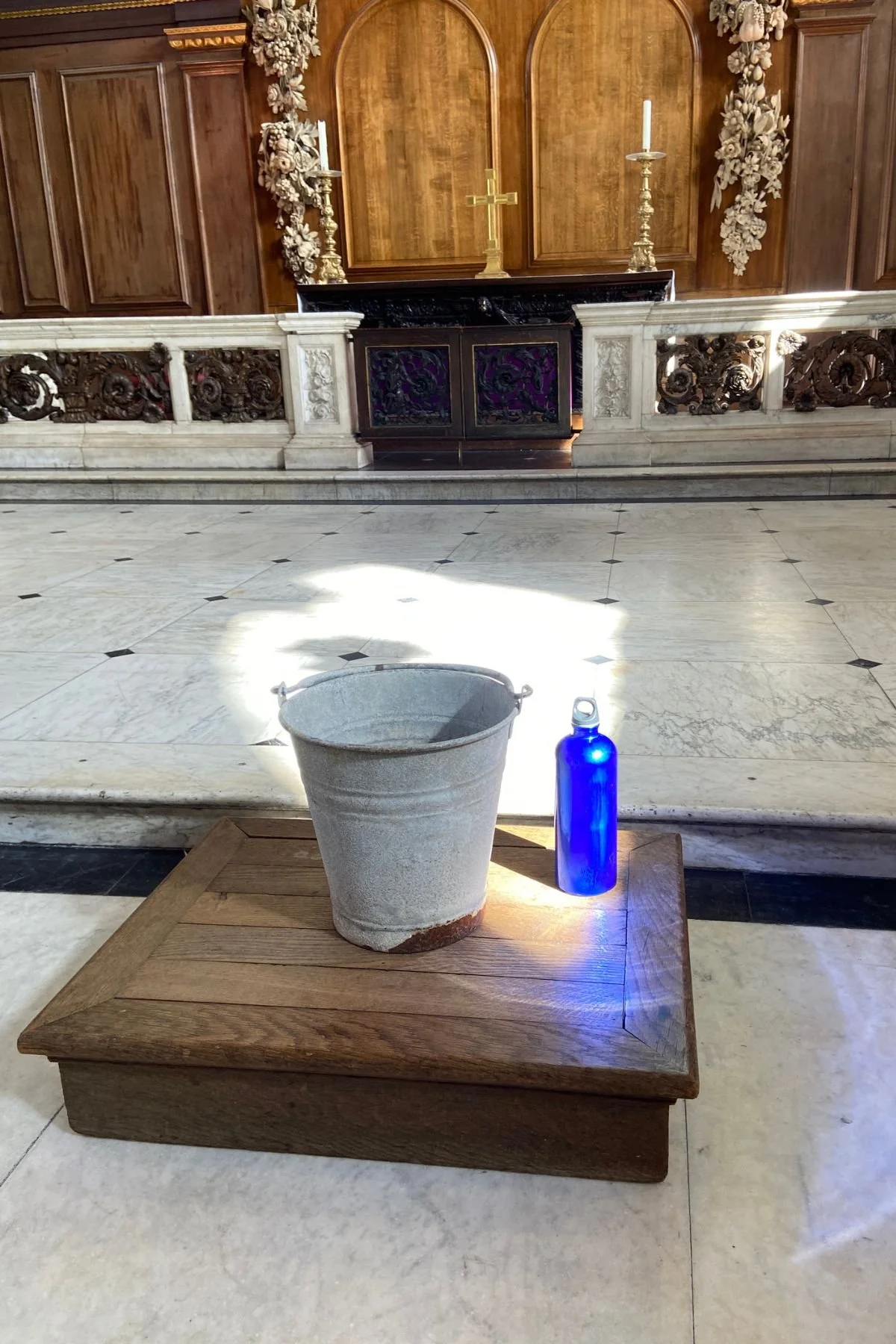
We carry two water samples with us.
The first is from a series of springs near Chesham, northwest of London. In winter this water bubbles up from saturated ground to generate a rare and beautiful chalk stream flowing overground. We know this stream as River Chess, flowing 11 miles from the Chilterns to the Thames. We have brought this water because it comes from the same underground source as the water in our wells, deep in the chalk beneath the London Basin. We keep the Chess water for the end of our journey.
The second sample is surface water brought from Reigate. Rain in Reigate soaks into the sands on the south side of the North Downs, and travels underground into London, notably to the fountains in Trafalgar Square (more on this later). We take this water with us as a symbolic offering to the dry, capped wells of the parish.
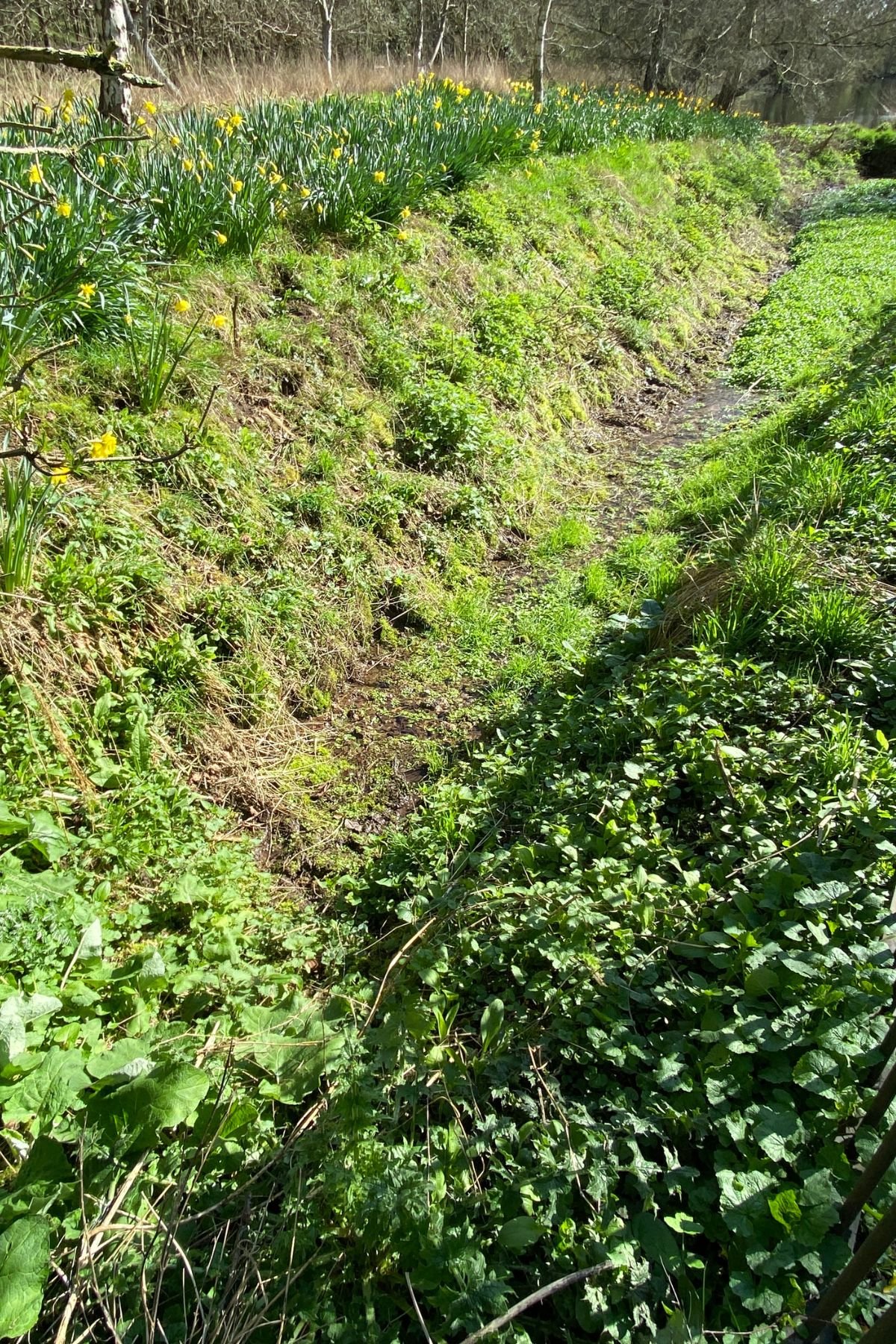
Chess Headwaters
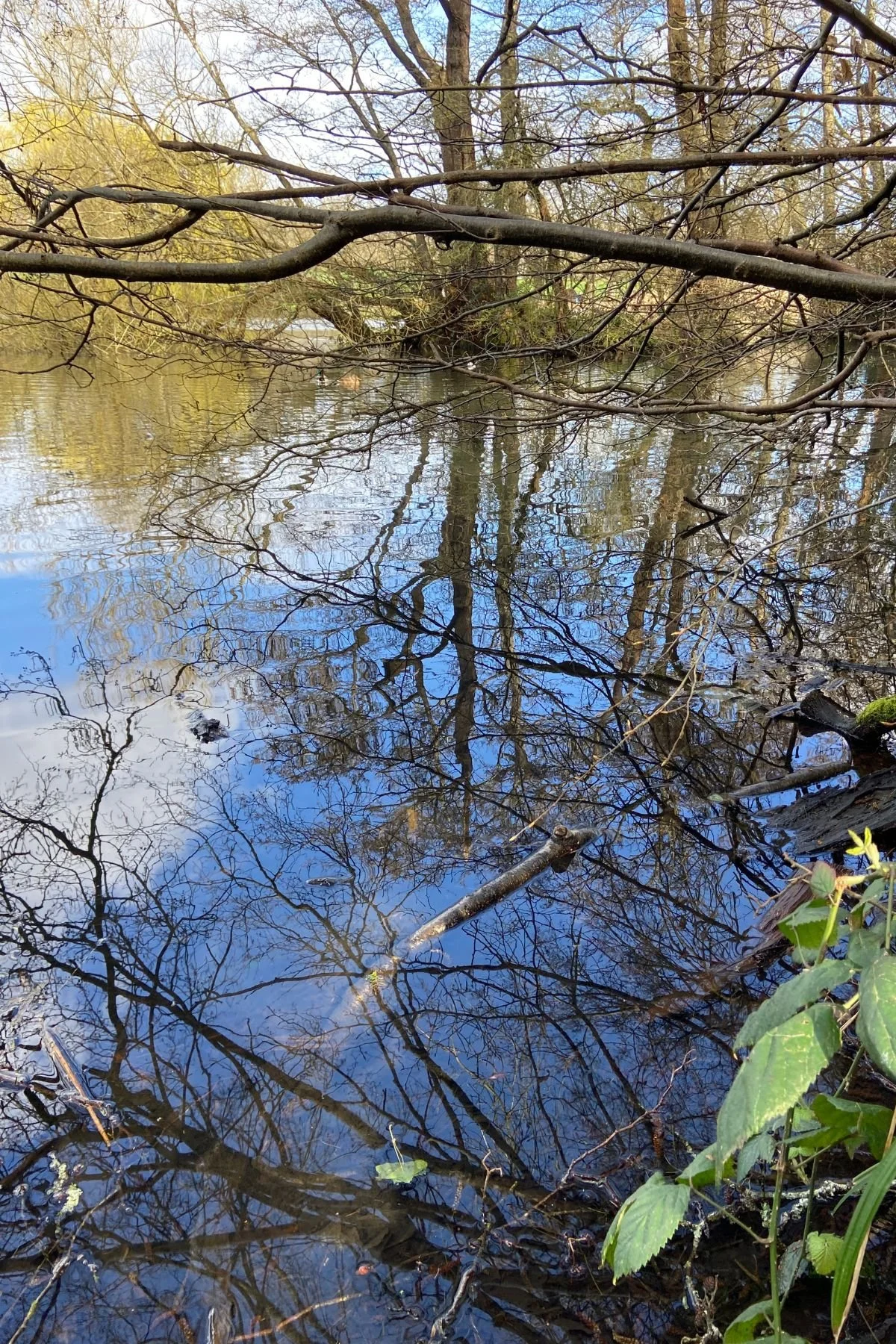
Priory Pond, Reigate
Mason’s Yard
We take some time to locate ourselves here in the Thames watershed.
We are in the London basin – imagine yourself if you will inside a giant soup bowl, with rims called Chilterns, North Wessex Downs, Surrey Hills, North Downs (perhaps confusingly to we London-centric folk, located to the south of us). The rim of this basin is mostly 100-200 m high. The Shard is around 300m high, so these are modest, human-scale hills.
The bottom of the basin is lined with multiple geological layers, traversed by countless water flows and reservoirs both above and below ground, with modern-day Thames flowing mainly above ground, mainly eastwards (although being tidal all the way from Teddington to the sea we should perhaps think of this stretch of river as a 50-mile estuary). Ice ages play havoc with watercourses, and the Thames once flowed much further north than its current comfortable bed, rising in today’s North Wales.
Immediately beneath our feet (underneath the millions of tons of concrete and bitumen that is…) are layers containing organic materials and alluvium deposited by water flows. Under this lies a great tumble of sands and gravels, brick earths, and clays, which dive down as far as the basin rim is high, and have variable permeability to water. Finally we reach the chalk which we can think of as the bottom of the basin, hundreds of metres thick. The chalk is made from billions of organisms with chalky skeletons who died in a warm tropical sea around 150-100 million years ago, then slowly settled and compacted on the seabed.
Chalk is the ultimate reservoir into which we poke our wells, but in the 19th and early 20th century in these parts, there was also plenty of water to be had from the overlying sand and gravels as you can see from the chart.
If the chalk is the bottom of the basin, then the overlying sedimentary layers are the soup, and we live our lives on the surface of the soup. It’s not a bad analogy as its so very watery beneath our feet.
Mason’s Yard was originally constructed as a stable yard for horses as Lord Jermyn wanted this essential facility to be hidden from the grand houses in St. James’s Square.
We are very near the headquarters of BP in St James’s Square, so this is a good place to reflect on extraction and the abuse of power.
Water, a life-giving and shared gift, should be available to all, to plants, insects, animals and birds as well as humans. But the world’s rivers are everywhere constrained, polluted with sewage, plastic, and toxic chemicals. Many are flooding or drying out as our familiar climate undergoes radical change. Robert MacFarlane’s book Is a River Alive? ends with a journey along the Mutehekau river in north-east Quebec. The river is threatened with a dam, a huge sweep of concrete that will bring exercise gyms, pool halls and bars to a wild mountain terrain.
There have been landmark legal cases in New Zealand and Ecuador which have granted rivers the right to legal protection, seeing them as ‘an indivisible and living whole’ a ‘spiritual and physical entity’ with a ‘life-force’. And yet it is likely that future wars will be water wars.
Now in this season of Lent, let us have a moment of silence as we reflect on the many ways that humans have exploited and desecrated the gift of water.
We give thanks to the Creator and Giver of waters. For the ancient waters lying beneath our feet, purified and nested in the chalk, blanketed by clay, released under artesian pressure to sparkle in the light. We honour this ground, this place. Here.
Well, we offer you this water drawn from your headwater. Be well.
Waterloo Place
It’s not known when the first deep well was sunk in this area, but there’s no evidence of any before the mid-18th century. It’s probable that earlier attempts ended in disaster on encountering the sands below the clays. Most of the successful wells carry into the chalk. Digging boreholes really ramped up in late Victorian times and in the early 20th century, resulting in a dramatic drop in the water table.
How successful the wells were was pretty much a matter of luck depending on whether a water-filled fissure in the chalk was struck or not. Wells quite close together could have radically different yields as you can see from the chart. Much local knowledge of the layers below was gained by the success or failure of wells.
The wells are essentially deep round holes, maybe a few feet across, lined with brick or stone to make a reservoir at the top. Below this, a much narrower borehole allows water to ‘well up’ under artesian pressure from below. At the start of the 19th century, picks, chisels, and hammers, were the order of the day in building wells and it could take years to sink to a meaningful depth, but dramatic technological advances across the century introduced percussive drilling, rotary drilling and use of compressed air. A major problem was sand bubbling up and choking the pumps, so later wells were double-lined with metal and compressed air was forced down the gap between the linings, forcing a mixture of air and water up the inner tube.
We read Diane’s poem ‘Piccadilly Well’
Among the rushing feet
a passage punched
through humus, gritty gravels, sand, brick earth
down into chalk and clay
into layers of deep time
a connecting rod
a lifeline whose living waters fed
insects, birds, people, drawing close
Its own communities
and even now
could link cretaceous seams of Gault clay
with our brittle surface world
place Eocene chalk
in dialogue with the Ritz.
It longs to catch the clouds
inside its upturned glass
at noon to feel new-minted
as a gold coin of sun.
It longs to send the sky
slopping, splashing light
to toss it into wild-flying drops
from a bucket rising fast
through its circular core of air.
This tube of slippery stone
possessed its own distinct voice
a pipe which was played by a passing wind
it is now a stoppered mouth;
a blindfolded eye
closed by a concrete clamp.
Now plunged for more than a century
in earthy pungent dark
it waits
a black pool of silence.
Be well, well
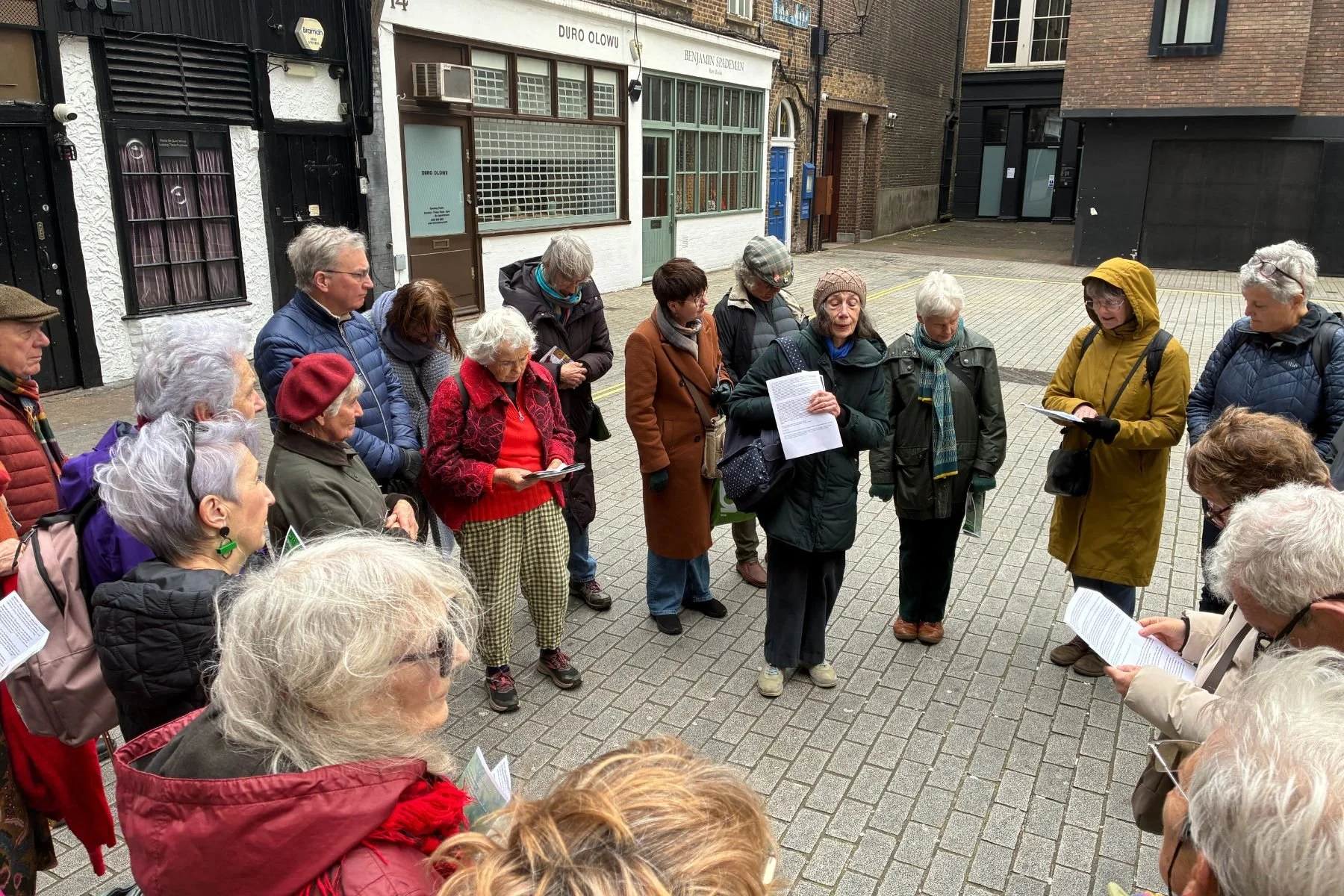
Gathering at Mason’s Yard.
The Dilly Hotel
Inside the foyer which is directly above the likely location of the well
Chalk is an aquifer which we tend to describe as rock that holds water, or allows it to flow, like a cup or a pipe. Fissures and breaks in the rock might behave like this, but mostly chalk is like a 180m thick sponge, full of water closely held in tiny pores, the chalk holding 35% or more of its own weight in water. The rock-water system is under pressure because of the layers above and below so if a borehole pierces the chalk, pressure is released and the water wells upwards. That said, there are large and small ponds and lakes stacked up below our feet, all across the London Basin.
This well is associated with the former Piccadilly Hotel, an elegant Edwardian landmark favoured by George V. Over the years it has changed owners and its name, but always projected luxury. The well drills down through layers of ancient rock and into living streams, providing us with a psycho-spiritual metaphor.
Our surface self is constructed to be looked at and projected, and like the Dilly Hotel might reflect changing fashion and ideas of status and power. Beneath this our submerged self carries layers of life experience, perhaps trauma and clogging deposits of memory, like sediments piled up. And in our deepest selves, spiritual depths both visited and unplumbed.
We celebrate these wells, isolated and consigned to darkness, as a metaphor for hope, connecting the surface to underground living streams. May your living waters nourish and flow between us.
Be well, well
Broad Street
We heard previously that the chalk layer is consistently thick – about 180m - but it’s not a level playing field down there. Punching hundreds of boreholes (and more recently, use of remote sensing technology) has shown that the chalk is just a few feet below the surface where we are standing in Broad St, but then drops away quite dramatically north and south. It also drops away east and west but not so steeply. So the bottom of the London Basin contains a hill of chalk with its ridge running more or less along Oxford St. A glance around shows that this is not related to the hills on the surface which are made of other sediments and piled up to various heights. Some very complicated geology is going on, but even so water makes its way up and out, as demonstrated by the abundant springs of Hampstead Heath emerging from sands and clays.
There was a cholera outbreak in this area in 1854. 500 people died in just 10 days. Local doctor John Snow mapped the cases and concluded that the communal water pump in Broad St was the problem – quite a leap for a culture that believed disease was airborne as ‘miasma’. He convinced the Board of Guardians of St. James's parish to order the removal of the pump handle which they duly did on 8th September. John Snow’s evidence-led, innovative thinking deduced a connection between overcrowding, contamination of water supplies by raw sewage flowing in the streets, and disease. William Blake was also born near here and later baptised in St James’s church. A visionary location!
Be well, well
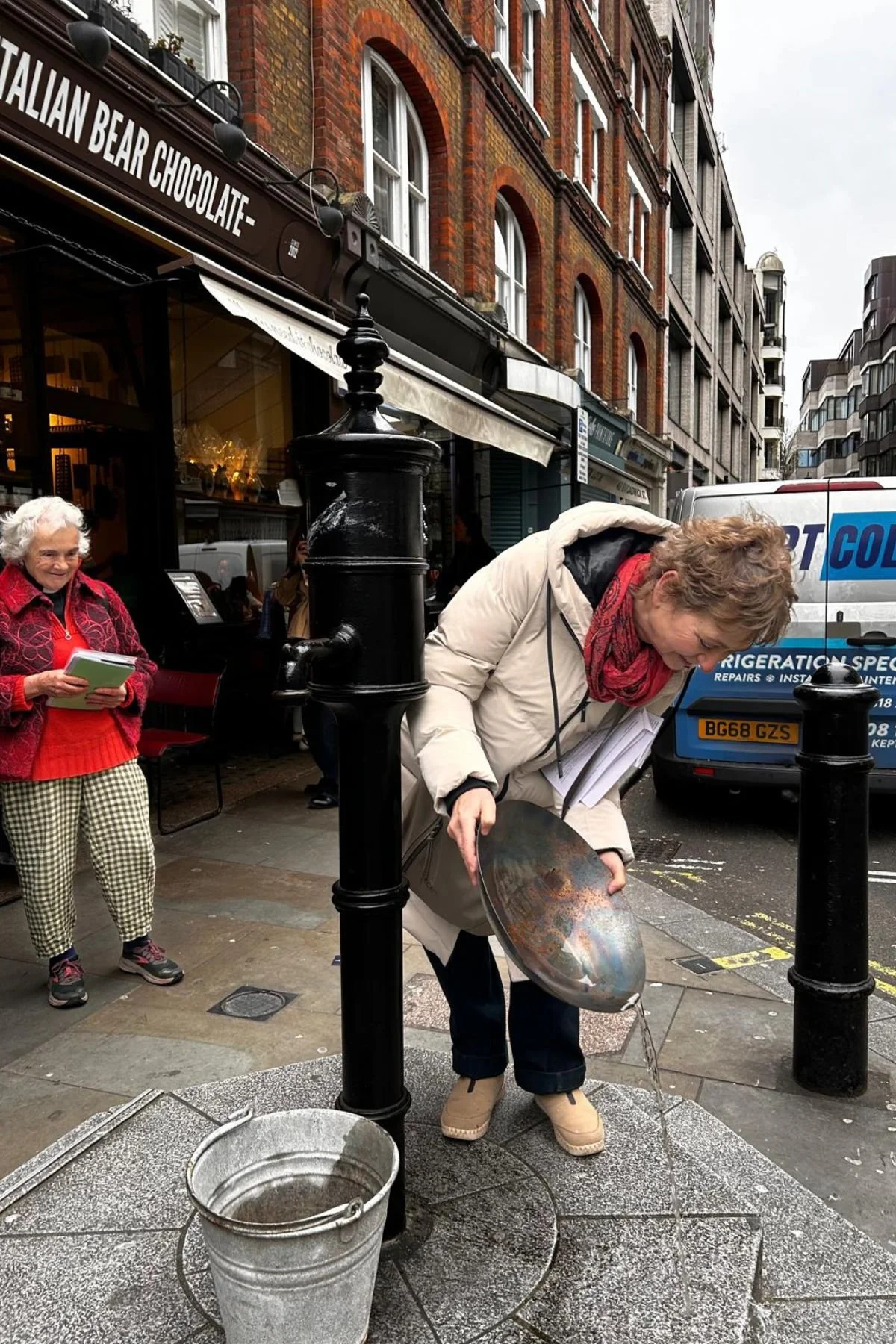
Carnaby Street, Golden Square
In Golden Square, like all our stops, we find a mixed and sometimes chaotic human history above-ground. The Square, possibly designed by Christopher Wren, is on the site of a plaque pit. It rapidly became the political and ambassadorial district of the late 17th and early 18th centuries, housing embassies. In 1780 the anti-Catholic Gordon riots erupted violently into the square.
Singers and artists have lived here, including Angelica Kaufmann, whose art was exhibited at the Royal Academy in 2024.
Here Thomas de Quincey, then a 17-year-old down on his luck, said his goodbye to Ann, his 15-year-old sex worker friend. She had spent her only money buying him a lifesaving tonic.
According to Charles Dickens, by the mid 19thcentury, this was ‘a quarter of the town that had gone down in the world, and taken to letting lodgings’, full of European musicians and singers. By 1900 it accommodated 70 yarn companies. It now houses media and advertising, including the global HQ of Saatchi.
So, a chequered history, reflecting shifts in status, power, technology – and violent prejudice. Meanwhile the hornbeam in Golden Square lives the different rhythm of the seasons. And below-ground, geological time exists in layer upon layer. Ancient strata of rocks hold the flow of streams.
It is very wet underfoot… but how does all that water get in there? Through the chalk outcrops round the rim of the basin which are largely free of impermeable clays. When it rains, the dry faces of these porous slopes rapidly absorb huge volumes of water which then makes its way many miles through well-worn channels under London.
We think of London water as ‘hard’ but it’s not as hard as Chilterns water because pressure from above squeezes the chalk below London, making it less porous and forcing much water to run through the overlying sands which act as a softening agent. These sands contain sodium salts from the original seawater trapped beneath the marine beds as they were laid down. The more pumping that has gone on, the more this saltiness is removed, so water extracted in the London Basin becomes progressively ‘sweeter’ over time.
We take some time to remember Lisa Barrott, much-loved member of St James’s and the Earth Justice group. Lisa was a water engineer and taught us a lot.
Be well, well
Now we cross Regent St and walk along Conduit St, then Bruton Lane, following the route of the ancient Ty-burn
Hay Hill
Welcome to this place of two waters. The well here is 450 feet deep with a historic flow of 3,200 gallons/hour. To give you some idea, it would take 7–8 hours to fill a London double decker bus. Quite something to have living in your basement!
We are on Hay Hill, named not after dried grass, but the crystal-clear chalk-stream that once flowed here down to the River Thames. The Ayebourne, first recorded in AD 951 as Teo Burna, or Ty Bourne, Aye Bourne - today, the Tyburn. This river was once an important supply of drinking water and remained overground into the 19th century, habitat for a vibrant ecosystem of dragonflies, water voles, kingfishers and brown trout, and the human beings who came to collect its waters.
We ponder our kinship with these two waters, considering our wells and streams as neighbours and fellow parishioners. Thomas Berry wrote that ‘the universe is a community of subjects, not a collection of objects’. Beings to be communed with.
‘At the Wellhead’ by Sara Mark
I once shared a cottage with an underground stream that fed a well in my front garden. They prompted me to write this poem.
"He stands at the door and knocks.
I answer but
find a curious absence
like exhaled breath early in a garden.
He'd entered long ago
in some heart-crack moment
and lay ignored curled dust-dry and parched.
The house all tsunami dark.
Was buried and on the sixth hour weary broken lay
crumpled at the wellhead asking
'Woman, give me a drink".
So she went with hook and rope down
fifty years rubble full.
And he said:
"Let down the bucket where you fear most."
Here, under this floor the blind stream surrenders seaward.
Its wellspring pulls up heavy and cold,
So sudden bright into the light,
tasting of soil tang and a pale circle of sky.
"... all heaven and earth and
of your own do we give you."
I pour, He drinks.
He pours and I thirst no more.
Be well, well
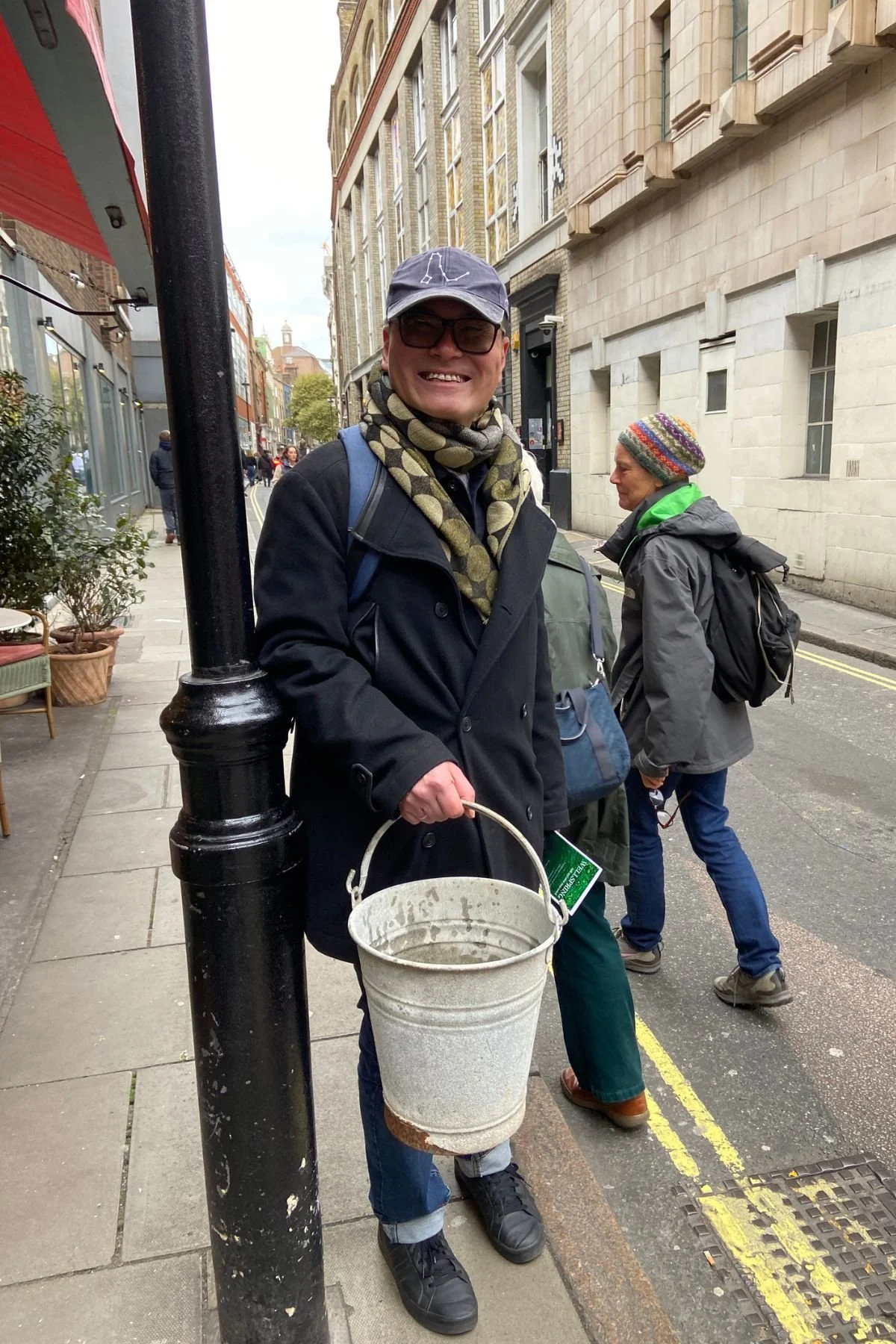
Hatchett’s Hotel
This is a very narrow well, one of the earliest in the area, sunk in 1820 before water abstraction began in earnest. Consequently the water rose to within a few feet of the surface under artesian pressure, but there is little information available.
Hatchett’s was originally The Old White Horse Cellar, one of the best-known coaching inns in England. It rose to prominence under Abraham Hatchett, who relocated the inn from the site of the present-day Ritz. Its real draw was the cellar, where people gathered to gossip, discuss the news and share a drink.
In the Celtic tradition, wells were thin places, connecting us to the sacred presences of water and light. They were revered as sites of healing and became places of pilgrimage. One example is St. Bride’s church in Fleet Street, a place of pilgrimage dedicated to St. Brigid, which traces its origins back to Roman Londinium. Before Brigid was revered as a Christian saint, she was known as a goddess of healers, poets, smiths, childbirth and inspiration. Her name means "exalted one".
Here on the site of one of the oldest Westminster wells is a good place to reflect on residence time of water in the confined aquifer below. Water flows but it also stays. The rate of flow of water through chalk is not an exact science and depends on how much fracturing and fissuring is present, but a recharge event (otherwise known as a downpour) in Reigate will impact Trafalgar Square and Charing Cross station in a matter of days. But important to say that the water that surges up in central London is not the same water that rained in Reigate that week. The rain enters the system and pushes resident water up, down and every which way. We can play a sort of Pooh sticks game, dropping a radioactively tagged water sample in Reigate, and waiting for it to arrive in Trafalgar Square…. And also directly test water from deep underground. If we reopened this borehole, the water we draw up will likely have been underground for 10 000 to 25 000 years. This water is melted ice from the last ice age.
Be well, well
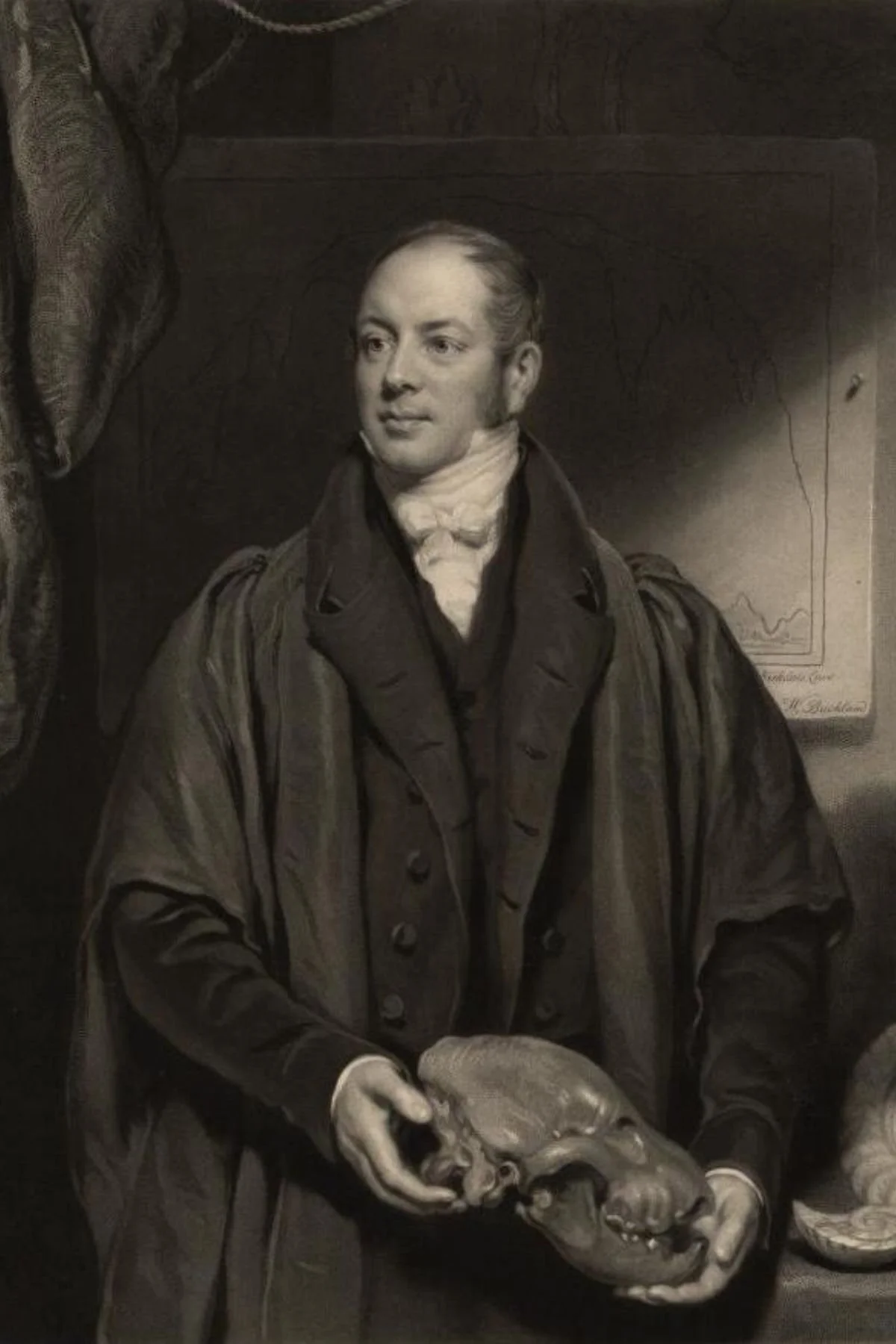
Rev William Buckland
The Ritz
William Buckland (1784-1856) was a geologist and theologian, and also Dean of Westminster from 1845-1856. His story tells us a lot about learning and changing our minds. Earlier in his life he subscribed to Gap Creationism, which posits a timeless gap between the first and second verses of Genesis 1. It goes like this:
Genesis 1:1 ‘In the beginning God created the heavens and the earth.’
Then we have a gap with accompanying explanation:
‘Genesis 1:1 forms no part of the first day but refers to a period of indefinite antiquity when God created the worlds out of nothing. The commencement of the first day's work I hold to be the moving of God's Spirit upon the face of the waters. We can allow geology the amplest time...without infringing even on the literalities of the Mosaic record.’
And then we return to Genesis 1:2 ‘Now the earth was formless and empty, darkness was over the surface of the deep, and the Spirit of God was hovering over the waters.’
He also interpreted his early geological discoveries as evidence for Noah’s flood but was later persuaded by theories of glaciation.
William Buckland seems to belong to the ancestral lineage of Thomas Berry who called himself a geologian, ‘a human being who has emerged out of eons of Earth’s geological and biological evolution and was now reflecting on our world. This reflection was a way to reinvent the human at the species level’. In order to do this reflecting, he needed to muster the truths presented by both the earth and his faith.
One hundred years earlier, Buckland was also wrestling with the nature of evidence and its interpretation, and breaking down human frameworks that were simply not big enough.
Samaritan Woman by Diane Pacitti
It was the place of women’s work, the site
of the marriage test. It was where the patriarch’s man watched Rebekah pulling, pulling water
for each of his ten camels.
This was the place
where Jacob first saw Rachel, and he rolled
the stone from the water-mouth.
Anyone
who read the Hebrew scriptures knew the script
when boy meets girl at a well.
Enter woman alone.
Something is wrong. No-one goes to the well
at noon, when water drops low in the earth
shrinking from the sun’s glare. And no companions?
A woman to avoid. Keep her from the children.
Five husbands, and now a lover.
Enter also alone
a travel-tired Jew. They face each other
across the well, across the barricades
of gender, race, religion. With no preamble
he asks her for a drink.
When she, the shamed one,
is turned into the giver, something hidden
moves deep within her, like a tiny trickle
pushing against rock.
They talk, a scandal
in full view – this unaccompanied woman
lingering with a stranger.
They communicate
face to face: she is bursting with new questions.
She draws out this man; she plumbs depths
unknown to his disciples.
With each exchange
strange things occur:
the age-old, prejudice-hard
barrier that has reared each way she turns
dissolves, to give her glimpses of a life
that is open, fluid:
God is unmoored
from Jacob’s mountain, from the man-constructed temple in Jerusalem and flows
free in the human spirit.
No wonder that her pot
is left by the well. It is too small to enclose
the rush of living water.
Be well, well
Piccadilly Arcade
The volumes of water held in aquifers are prodigious. In 1845, ‘The Illustrated London News’ published an article about the new fountains in Trafalgar Square and the two connected wells which supplied them:
‘300 gallons per minute raised for 30 hours in succession lowered the water in the wells only 50 feet.’
That’s two thirds of an Olympic swimming pool spouting through the fountains every day, easily replaced by new water falling as rain in the vicinity of Reigate on the south side of the North Downs, and percolating in through the sand that extends right underneath the chalk. The sand in turn rests on the impermeable clays of the weald. Unable to sink further downwards through the clay, the water sets off for London through the sand, wicking upwards into the bottom of the chalk on route.
The Illustrated London News comments: ‘on reaching the site of London (the water) forms a grand reservoir at a depth of upwards of 250 feet beneath the valley of the Thames.’
The Illustrated London News was the first weekly magazine in the world. Its founder explicitly responded to the evidence that people bought more papers if they contained pictures and shocking stories, and the first issue in 1842 was timed to coincide with Queen Victoria’s first masquerade ball. It’s gratifying that readers also appreciated engineering triumphs and geological exposés. These burgeoning fields of enquiry driven by the nascent industrial revolution, but also responding to the unique, ancient and endlessly varied geological profile of Great Britain, were rapidly becoming intellectual mainstream and igniting imaginations.
As the Samaritan Woman poem that we heard earlier makes clear, wells are of crucial importance in the Hebrew scriptures, both as a source of life and as a catalyst for stories.
In a parched hot land, wells gathered around them a community of people, and women had the task of drawing water. They were daily meeting-places. But they also attracted travellers who had journeyed far and arrived exhausted and thirsty, concerned about the state of their animals. So they allow for the practising of hospitality, and new, unexpected relationships. Rebekah passes the marriage test when Abraham’s servant sees her draw water not just for him, but for ten camels. Jacob rolls a heavy stone off the well so Rachel, his future wife, can give water to her herds. They are places of life-changing encounters.
Be well, well
Burlington House
Early Christians believed that as well as the book of the Bible, we have been given the book of nature, so that we can discover God in both. Much of the Protestant tradition narrowed the locus of revelation to the Bible so decisively that we may ask why we should see underground rocks and streams as sacred.
Of course, the Bible is full of rock and water. ‘My God is my rock, in whom I take refuge.’ (Psalm 18) Rock is seen as fixed, strong and unchanging.
Modern science has revealed other mysterious and awe-inspiring qualities of rock. Rock buckles and shifts its place in the globe. Mountains are eroded and shrink through the millennia. When we imagine the layers of rock under Piccadilly, we are staring into deep time.
We are all made of stardust, but rock feels closest to the minerals and dust of exploded stars. When we look at this timescale, our imaginations fail us and we feel our own tininess, as we do when we contemplate the infinity of God. Some indigenous traditions speak of Grandfather Rock and have no doubt that rocks are repositories of ancient wisdom and knowledge. And, brief as our lives are, we are connected to these rocks. They are our evolutionary ancestors.
Let’s just consider again where we are, in the middle of the London Basin with its chalky, hilly rim. Our lives here are lived out on a giant sponge, covered over by hundreds of meters of soaking wet sedimentary stuff. These sediments are piled up about halfway from the chalk lining of the basin to the top of the hills. If the basin was a bowl of porridge, we can imagine ourselves on the surface of the porridge, rather than the bottom of the bowl, with rivers and streams and wells and springs and lakes of oatmilk flowing everywhere through the porridge, and the bowl itself. We are surface creatures, but we are intimately connected to the rock-water system below, and as sea levels rise our dry surface will not stay dry.
Each well, each genius loci – and there are hundreds or even thousands – is a pinprick, a reverse periscope, a bold enquiry or extractive jab into this fluid meshwork beneath our feet, the contents of one well connected to the contents of all the wells.
The way we live here on the surface has repercussions for the whole system. Recently a plastic cup was found floating on the surface of a deep and inaccessible medieval well, which is sealed over and under a building. Was the cup carried by a river into a subterranean reservoir and pushed up into the well? What else travelled with it that we can’t see? What else percolates through the meshwork, from above and below?
Rock and streams. Water is the pre-condition for life.
Let us be still to contemplate the sacredness of rocks and water.
Be well, well
Back in St James’s courtyard we are invited to a closing ceremony. We receive water in our hands and offer gratitude, recognising ourselves as conduits. Water from the head of the Chess returns to the ground through our fingers.