
Encounter at the Wellhead: a pilgrimage to St Olave’s, Hart Street
Text by Diane Pacitti and Deborah Colvin.
St James’s Courtyard
We gather in St James’s courtyard for our second pilgrimage inspired by the wells and boreholes of London. This time our pilgrimage is part of the Season of Creation, whose theme for 2026 is Living Water, and we venture beyond the parish, walking eastwards for about 4 miles. We will stop by the hidden sites of holy wells and end at St. Olave’s with its ancient well in the 13th century crypt. On the way we will explore churches much more recent than the presence of water which created the first communities in these places: communities of plants, insects, birds, animals and finally humans.
These churches are often extraordinary structures built from rock, the substance through which water flows and rises. We will encounter human history in all its ugliness and its spiritual yearning. We will pass by the church built by the crusading Knights Templar, who fought a ‘Christian’ war we would now question; we will see churches with links to royalty; churches with memorials to people of worldly success and power. We will stop by Australia House, where the ancient well in the basement is covered by a structure of colonial power. And we will see worship expressed in wonderful forms of human creativity, through wood and ceramic tile and stained glass.
But the wells give us a very different focus. When we encounter them, we are returning to the very source of life. Most are hidden from our above-ground view, but they are fed by a network of underground streams, so that rainfall in Reigate can raise the water level of a well in Piccadilly. They bring us face to face with our most primal need. When we honour these wells, we are in tune with the communities who lived here long before us. They knew that the wells were holy, and we know that God is present in every part of the earth and cosmos, and that the Spirit flows through living water.
So let us be still and attentive. Let us listen for the voices of the submerged wells, aided by Sze’s soundscape. Let us see them as thresholds, entry points to the depths of our souls. And, as we encounter the wells, let us be open to being changed by them.
We read Ezekiel 47: 1-6 while orienting ourselves to the East, the direction we will walk, following the abundant flow…
The man brought me back to the entrance to the temple, and I saw water coming out from under the threshold of the temple toward the east (for the temple faced east). The water was coming down from under the south side of the temple, south of the altar. He then brought me out through the north gate and led me around the outside to the outer gate facing east, and the water was trickling from the south side. As the man went eastward with a measuring line in his hand, he measured off a thousand cubits and then led me through water that was ankle-deep. He measured off another thousand cubits and led me through water that was knee-deep. He measured off another thousand and led me through water that was up to the waist. He measured off another thousand, but now it was a river that I could not cross, because the water had risen and was deep enough to swim in —a river that no one could cross. He asked me, ‘Human one, do you see this?” Then he led me back to the bank of the river.
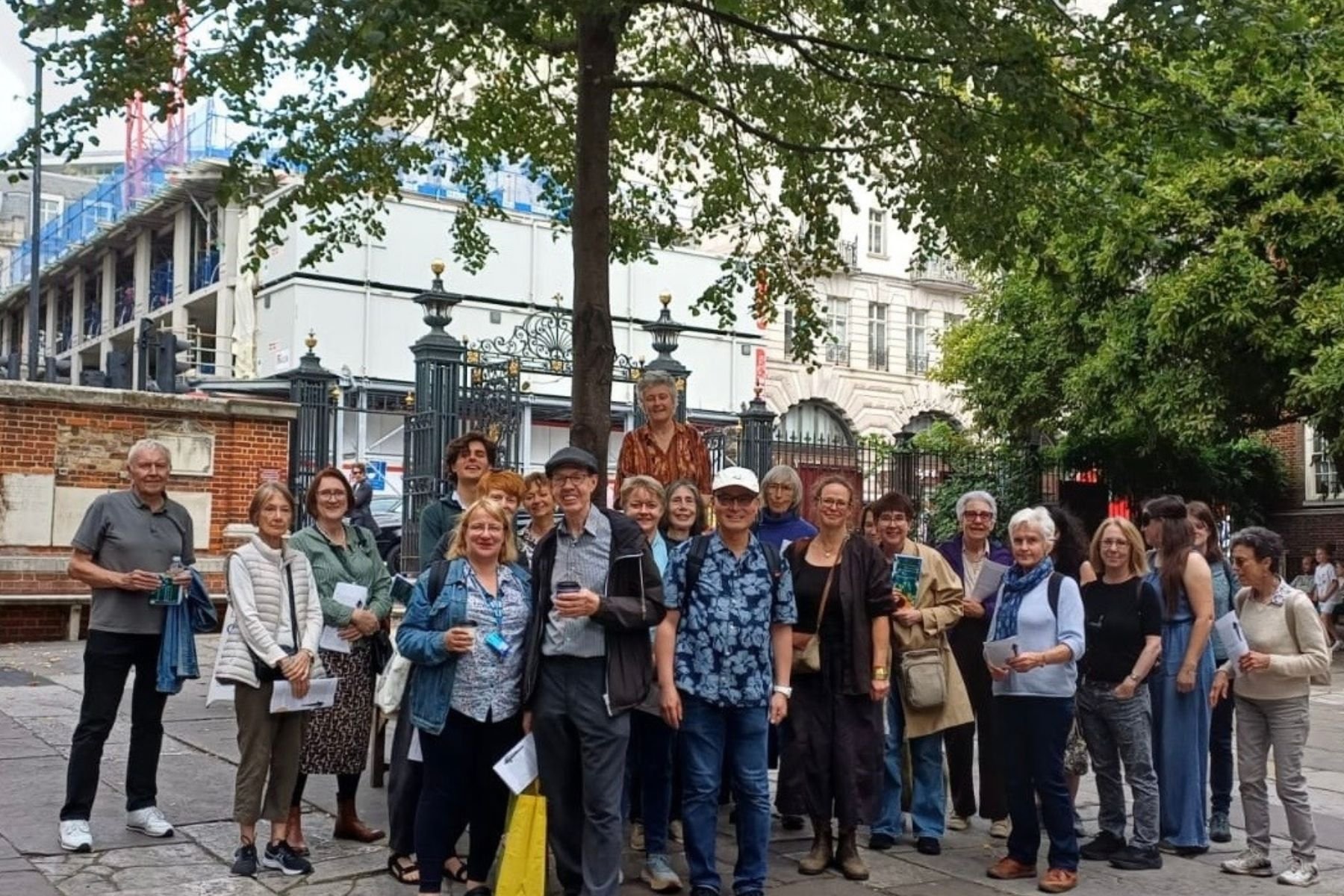
The beginning of our pilgrimage in St James’s Courtyard.
Trafalgar Square and St Martin’s in the Fields
We pause beside St Martin’s to salute the most modern borehole we know of - it’s about 20 years old and inside the church. As we leave much of Georgian London behind and continue our journey eastward into a much older city with older wells, we reflect that the water in the older wells is ‘younger’ water, in the sense that the wells of the City were originally much shallower and recharged with surface water more frequently. Westminster wells by contrast are more recent but bore deeper into the Earth, accessing water hundreds of feet below us. Some of this water has been there since the last ice age.
We look back at Trafalgar Square, with a reminder from our last walk: the volumes of water held in aquifers are prodigious. In 1845, ‘The Illustrated London News’ published an article about the then new fountains in Trafalgar Square and the two connected wells which supplied them: ‘300 gallons per minute raised for 30 hours in succession lowered the water in the wells only 50 feet.’
That’s two thirds of an Olympic swimming pool spouting through the fountains every day, easily replaced by new water falling as rain in the vicinity of Reigate on the south side of the North Downs, and percolating in through the sand that extends right underneath the chalk. The sand in turn rests on the impermeable clays of the weald. Unable to sink further downwards through the clay, the water sets off for London through the sand, wicking upwards into the bottom of the chalk on route.
The Illustrated London News comments: ‘on reaching the site of London (the water) forms a grand reservoir at a depth of upwards of 250 feet beneath the valley of the Thames.’
We walk on, aware of this grand reservoir under our feet.

Trafalgar Square Wellhead, 1845
Fountain Court and Holywell Street
The poet, artist and visionary William Blake spent the last few years of his life living in Fountain Court, now the site of the Savoy Hotel. He lived with his wife Catherine in two rooms, one of which housed his printing press and was his studio. All the business of living was crammed in the other room. Fountain Court was named after the Fountain tavern, but an early 20th century geological survey of the wells of London states that there were three wells on the Savoy Hotel site. From his back window Blake had a view of the Thames, which he described as ‘like a bar of gold’.
In the great ending of his prophetic book Jerusalem, Blake writes ‘the Furnaces became Fountains of Living Waters flowing from the Humanity Divine’ signifying the transformation of struggle and suffering into spiritual awakening.
The Savoy Well, Water Bottling Lab.
St Mary le Strand once connected to Holywell Street, which ran just north of the church and was part of a warren of medieval lanes and alleys. There is archaeological evidence that the Saxons lived here, so we can assume that the use of the well in this vicinity goes back at least to them. The area was flattened for the creation of the Aldwych in 1902.
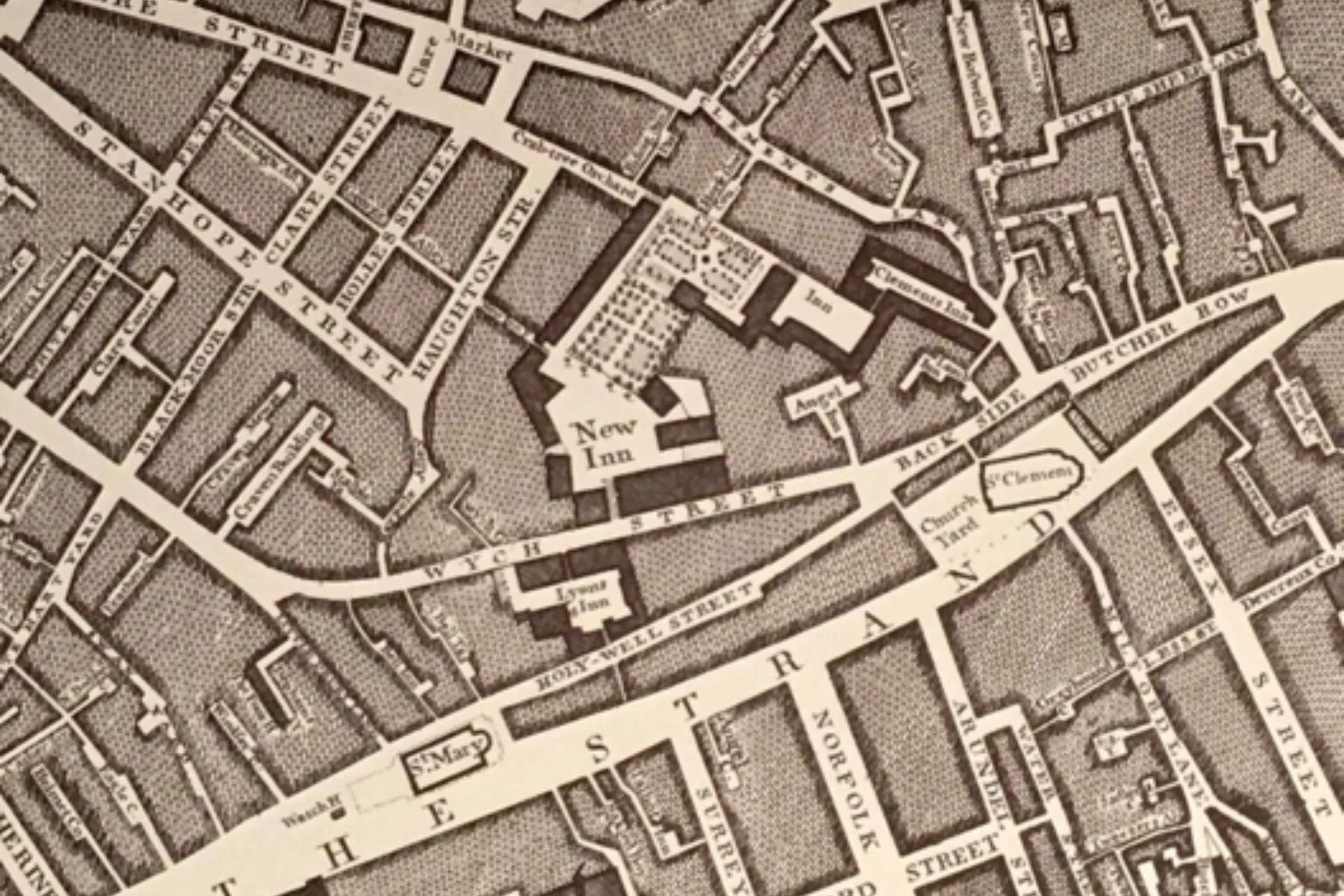
Holy Well Street map
St Clement Danes area
It’s suggested that in pre-Tudor times there may have been only 20-30 wells serving the whole of the City, and at least 2 or 3 of them were in this vicinity, at the eastern end of Holy Well street. In the basement of Australia House, there is a well fed by water from the now subterranean River Fleet. The building is a construct of empire, with a marble spiral staircase, crystal chandeliers. But hidden at the very bottom, this still-open well of fresh water, points through the earth towards the country that the building commemorates. This is the only well we’ve come across that still has visible water in it – we’ve not been able to gain access but Jack, tour guide for Living London History, has… you can find out more here. https://livinglondonhistory.com/australia-house-and-its-hidden-900-year-old-well/
Intriguingly, he describes how a plastic cup was found floating in the well. Perhaps it washed down a storm drain and was carried along the still-flowing underground Fleet river. On the west side of the Royal Courts of Justice under the car park (not where the 1807 plate now stands!) there is a well-documented old well. First mentioned 1180 and praised for its ‘sweete, wholesome and cleere’ water, it was 191 feet deep, with 150 ft of water, producing 30 000 gallons of water per day – welling up through a fault in the London clay. This well was a medieval pilgrimage site, and in 1373 it was described as being on the main road, the ‘Holy Way’. Some time in the 18 th Century it became a pump, probably because people threw so much rubbish into it that it had to be closed. It was eventually filled in in 1874 when the Royal Courts of Justice built.
So let us be still for a moment as we cut out the traffic noise, and the present-day buildings of pleasure and trade and wealth. We focus on the holy well or wells which brought life to this area, and were known to be sacred, while reflecting on the complexity of humans who can both designate a well as holy, and fill it with rubbish.
In 1969 Transport for London sunk a borehole in front of the church and struck water at around 85 feet. Records indicate that the depth of water changed by the hour and by the day, fluctuating by as much as 20 feet. The church is close to the Thames, and the effect of the tide can be seen in ground water levels, so perhaps the tidal Thames shapes the height of the water table below St. Clement Danes.
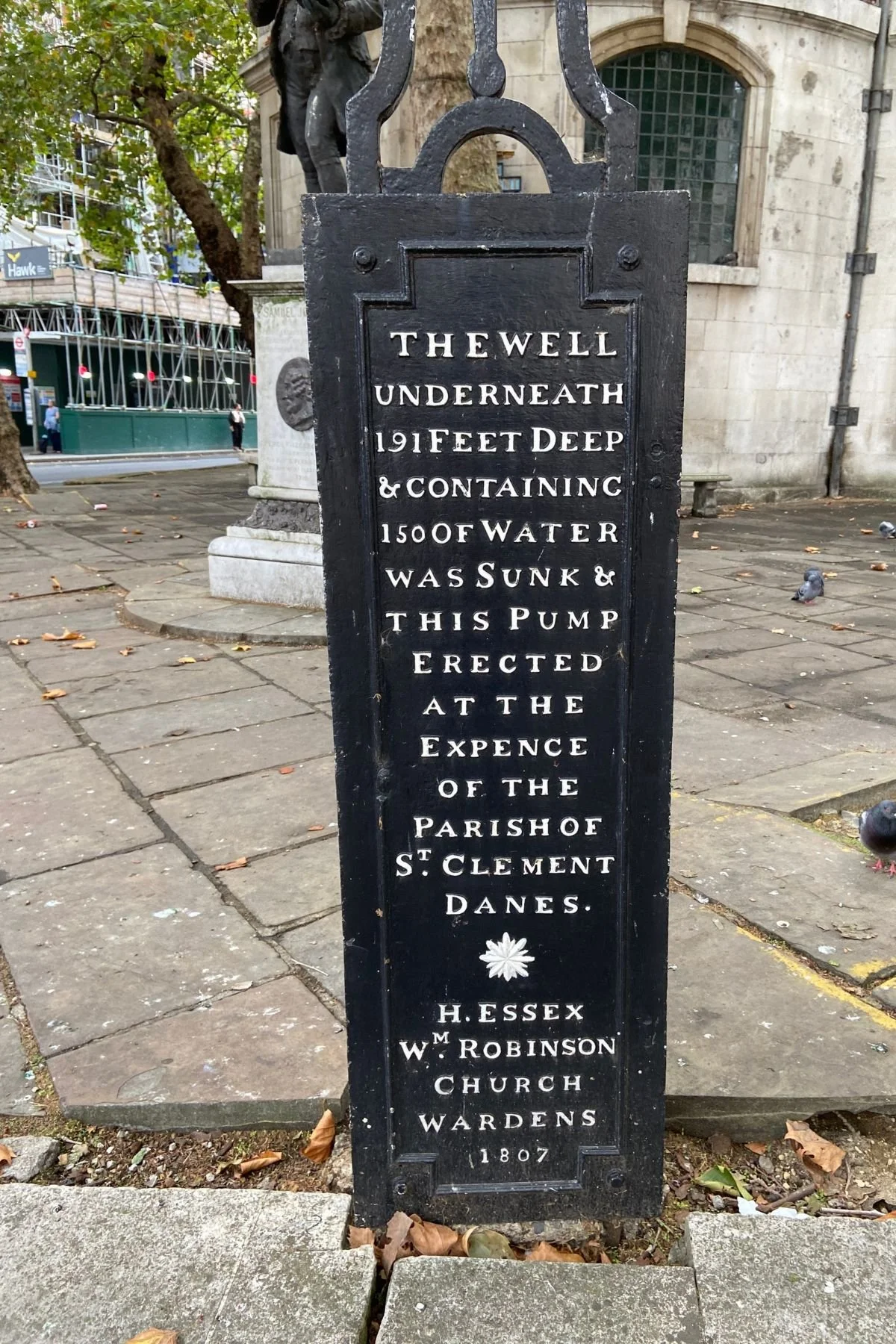
Monument at St Clements
St. Bride’s Church
We arrive at a church with a 2,000 year history, built on the site of a pre-existing holy well. In the crypt we will see Roman pavement and artifacts – the church is built on the site of a huge ditch which the Romans dug just outside the walls of their city. The church was rebuilt a number of times, and utterly destroyed in the Great Fire, after which it was rebuilt by Wren. From 1500 onwards this area was established as a printing area, and St. Bride’s is known as ‘the journalists’ church’.
But we are here to honour St Bride or Brigid, whose well is one of the most ancient in the city, dating back to at least the 6 th century. St. Brigid, the mother saint of Ireland, founded a monastery of nuns at Kildare. A fire was kept alive there for years to invoke her protection of cattle and the harvest. Amongst other things, she is patron saint of midwives, newborn babies, poets, dairy farmers and healing. Her hospitality is recognised in the legend that she could turn bathwater to beer.
St Bride is the patron saint of the British Pilgrimage Trust, which sees her story as a ‘radiant blend of pagan goddess and Christian saint’, and both pagans and Christians celebrate her on this site. Her feast day is 1 st February, the Celtic spring festival of Imbolc. Let’s not get hung up on dualities like pagan and Christian, we are here to encounter sacredness, and here we encounter aspects of water through a woman who heals, protects, nurtures and births. Her association with midwives and babies focuses us on the fluids of the womb and the passage into life. Her association with harvest suggests fecundity. As we contemplate her well, we are attuned to the life-giving properties of water. We are at one with the Celtic worshipper making a votive offering of a pebble, or an early Christian offering prayers, seeing in water the transforming flow of the Holy Spirit.
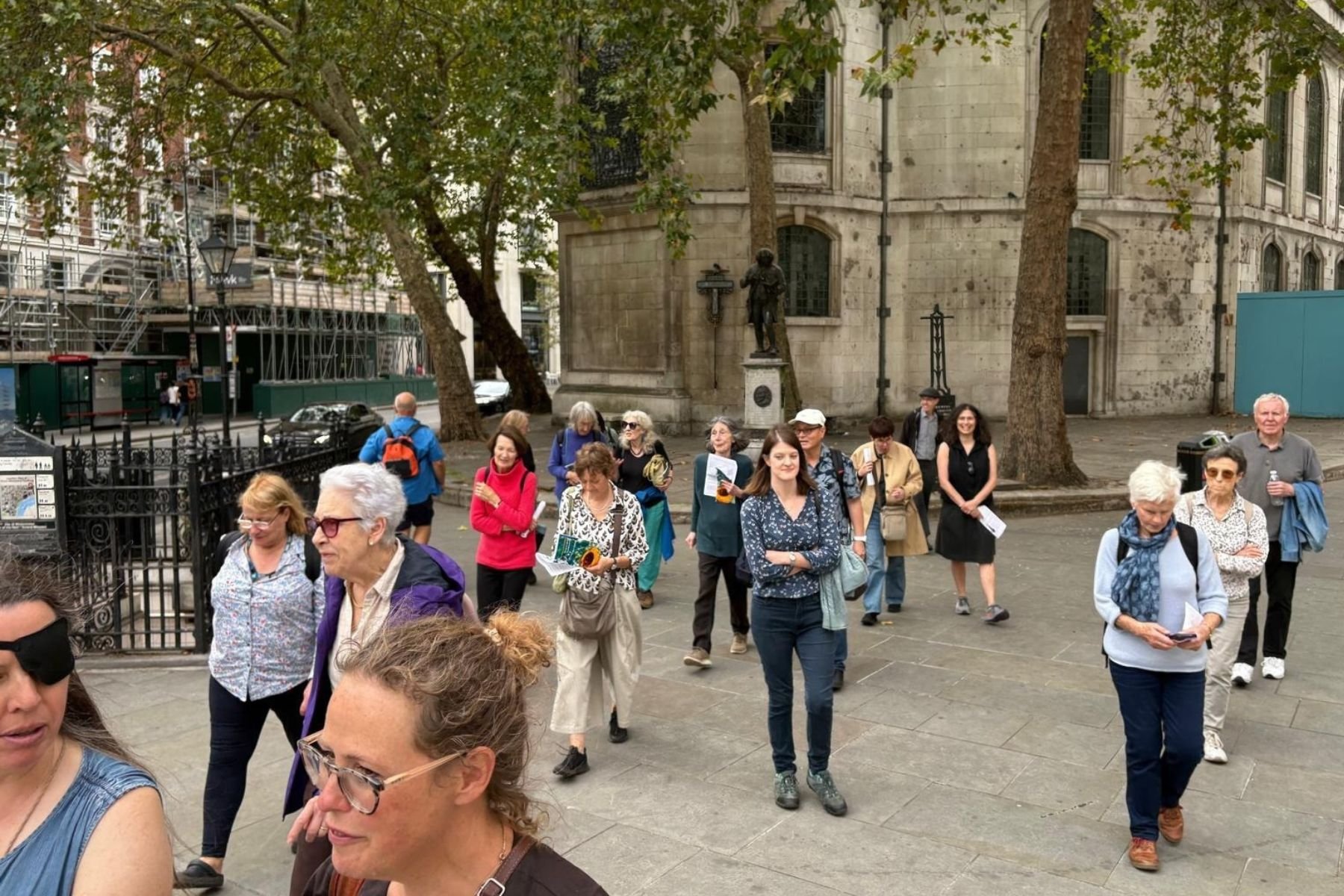
Walking along
St Andrew by the Wardrobe
This church was the last to be renewed after the fire, last to be rebuilt after the Blitz… but in the 2020s, it’s the FIRST in the diocese to achieve net zero, with roof insulation, underfloor heating, 6 heat pumps on the roof, rapid response electric radiators and a green energy tariff.
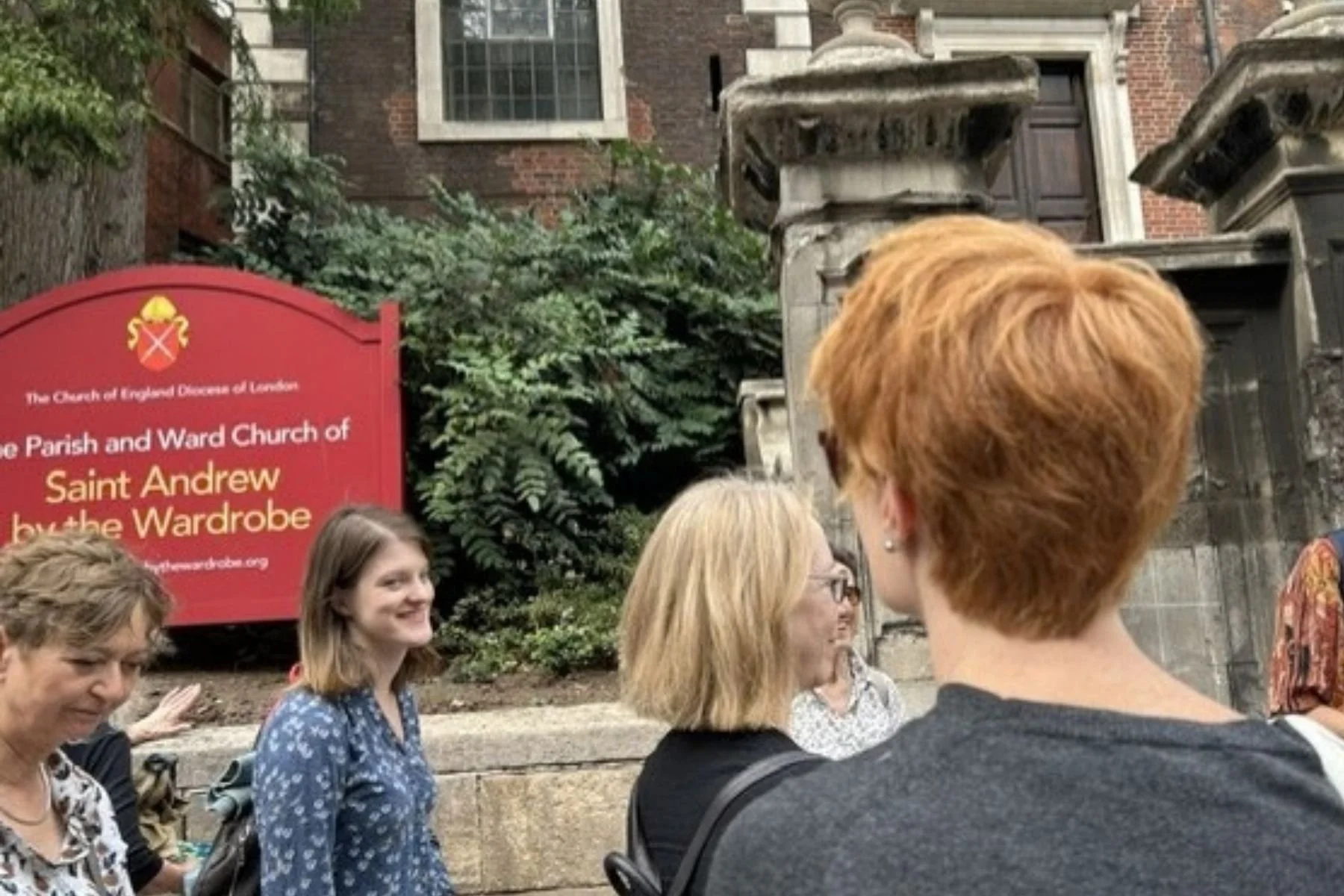
St Benet’s
We arrive at the home of the Welsh church in London. Gwenda reads for us in Welsh, first a poem by John (Ceiriog) Hughes about his longing (hiraeth) for his Welsh homeland, and then the Lord’s prayer.
St Andrew by the Wardrobe
Nant y Mynydd
Nant y Mynydd, groew, loew,
Yn ymdroelli tua’r pant;
Rhwng y brwyn yn sisial ganu,
O na bawn i fel y nant.
Grug y Mynydd yn eu blodau,
Edrych arnynt hiraeth ddug
Am gael aros ar y bryniau
Yn yr awel efo’r grug.
Adar mân y mynydd uchel,
Godant yn yr awel iach;
O’r naill drum i’r llall yn hedeg—
O na bawn fel deryn bach.
Mab y Mynydd ydwyf innau,
Oddicartref yn gwneyd cân,
Ond mae’m calon yn y mynydd
Efo’r grug a’r adar mân.
Mountain stream, fresh and sparkling
Twisting and turning toward the hollow
Between the whispering-singing rushes
O that I were like the stream!
The mountain heather in flower
Looking upon it brings hiraeth [longing]
To be able to stay on the mountain
In the breeze with the heather.
Little birds of the high mountain
Rising in the clean, fresh air
From one peak to another they fly
O that I were like a little bird!
I too am a son of the mountain
Away from home making a song
But my heart is on the mountain
With the heather and the little birds.
The Lord’s Prayer (1988 Welsh Bible)
Ein Tad yn y nefoedd, sancteiddier dy enw;
deled dy deyrnas;
gwneler dy ewyllys,
ar y ddaear fel yn y nef.
Dyro inni heddiw ein bara beunyddiol,
a maddau inni ein troseddau,
fel yr ym ni wedi maddau i’r rhai a droseddodd yn ein herbyn;
a phaid â’n dwyn i brawf,
ond gwared ni rhag yr Un drwg.
Oherwydd eiddot ti yw’r deyrnas a’r gallu a’r gogoniant am byth.
Amen.
Our Father in heaven,
hallowed be your name,
your kingdom come,
your will be done,
on earth as in heaven.
Give us today our daily bread.
Forgive us our sins,
as we forgive those who sin against us.
Lead us not into temptation,
but deliver us from evil.
For the kingdom, the power,
and the glory are yours,
now and for ever.
Amen
St Benet’s to St Olave’s
Now we drop down beside the Millennium Bridge and continue along the Thames Path all the way to the Tower where we curl around All Hallows by the Tower and on to St Olave’s. The Thames path is rich with interest, including evidence of historic docks and wharves and the River Walbrook estuary. We bear in mind that over time, the river has been hemmed in and enclosed as land has been claimed. Pilgrims in centuries past would have walked the bank of a much broader Thames quite a distance further north. You can see on our map that the wells of this area also run along an east-west line, picking out an older riverbank.

Detail from ARTBASH, an intergenerational project at Globe View on the Thames Path which we passed on our pilgrimage today.
At St Olave’s
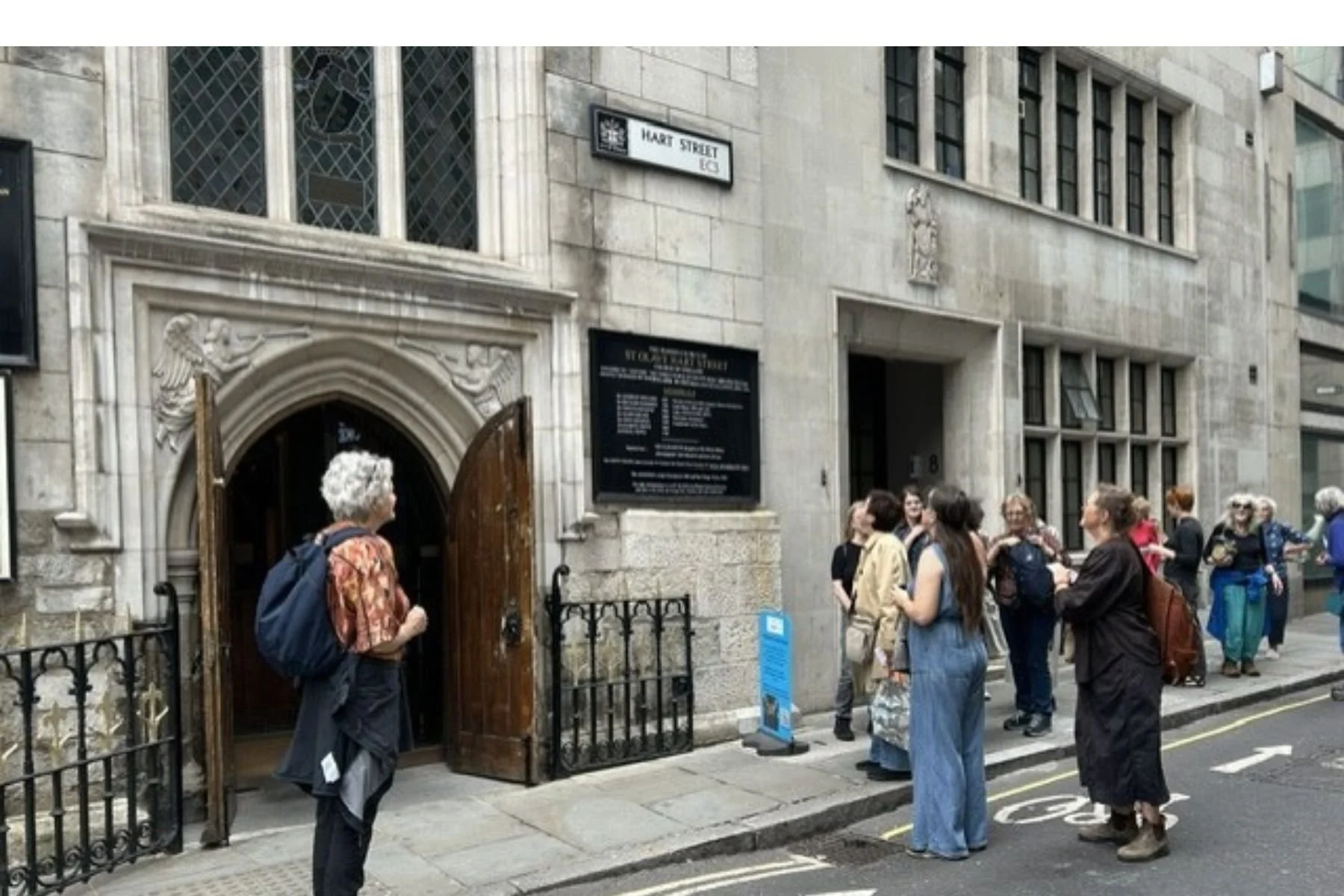
Arrival at St Olave’s, Hart Street
St Olave’s is a rare surviving medieval church in London and nestled in the crypt is a Saxon well. We descend 4 or 5 metres below street level to the well head. Sara Mark has been here before us and the well itself is glowing with light as the sounds of our ‘Ten Wells’ sound-piece, accompanied by calling estuarine birds, emanate from its depths and lead us into evening prayer, the end of our pilgrimage.
Thank you to Rev Phillip Dawson (first Rector at St Olave’s for 40 years!) for his warm welcome and service of blessing.
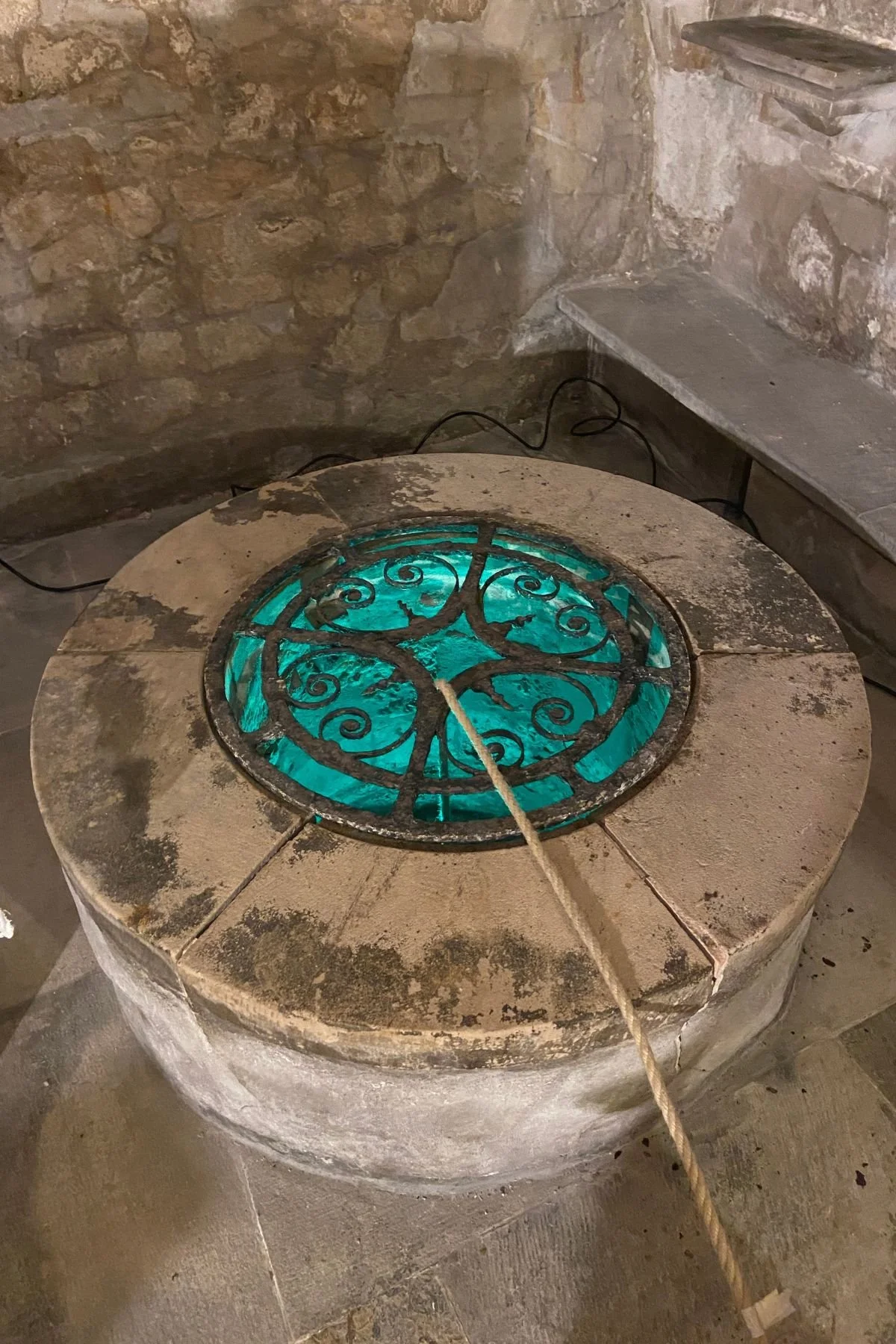
The Well in the Crypt of St Olave’s, Hart Street.
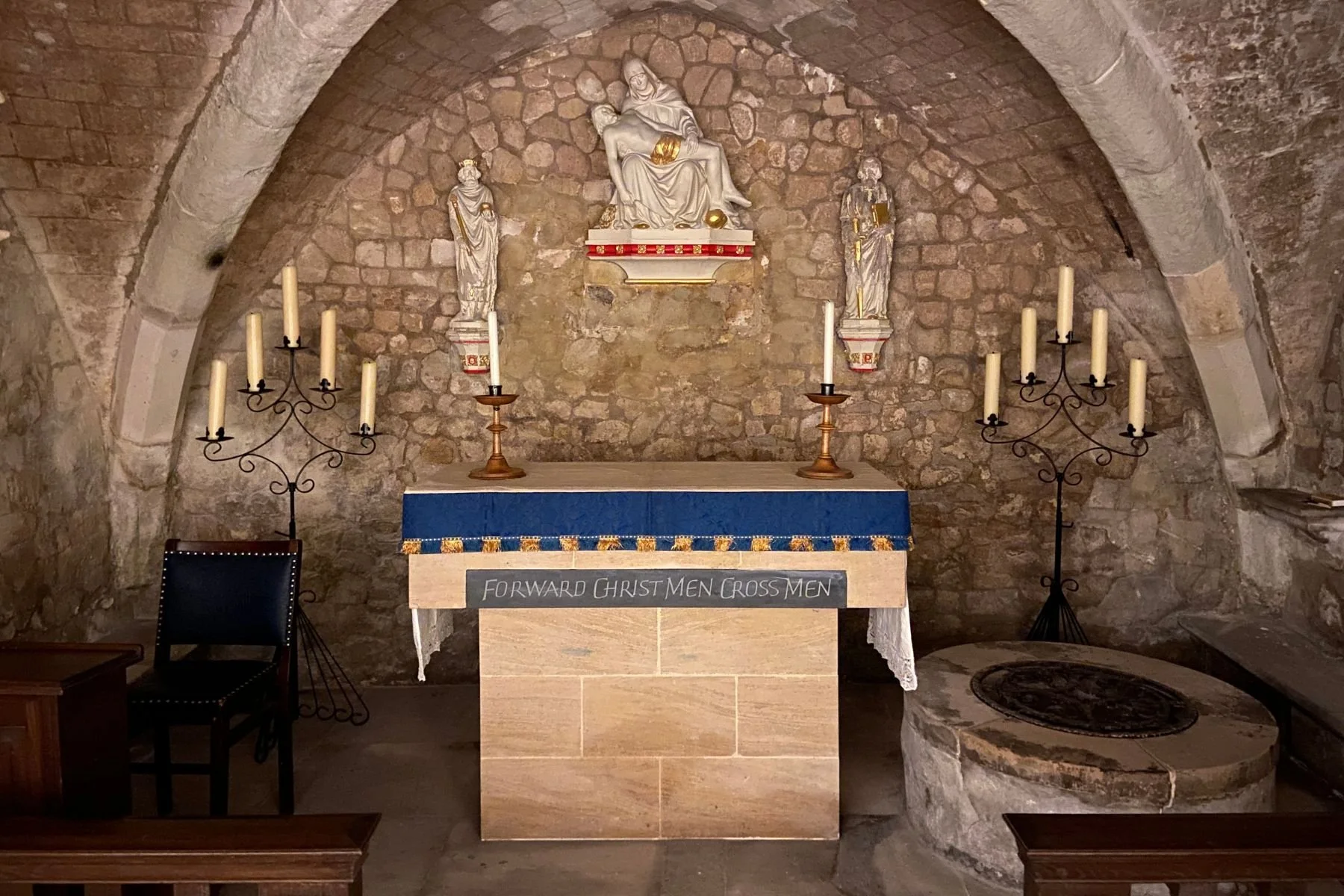
Altar in the Crypt of St Olave’s, Hart Street.
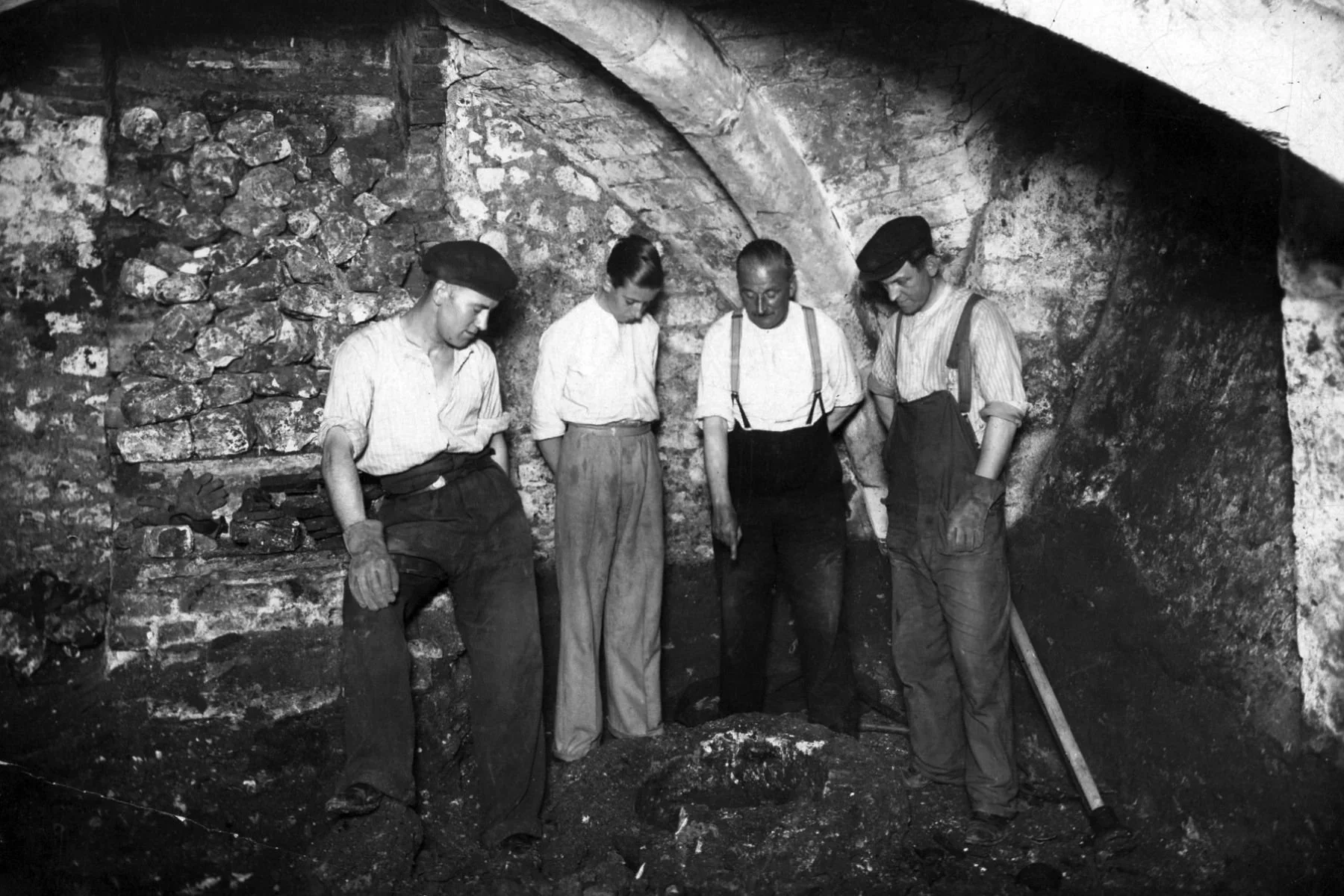
Workers at the Well in the Crypt of St Olave’s, Hart Street, 1935.
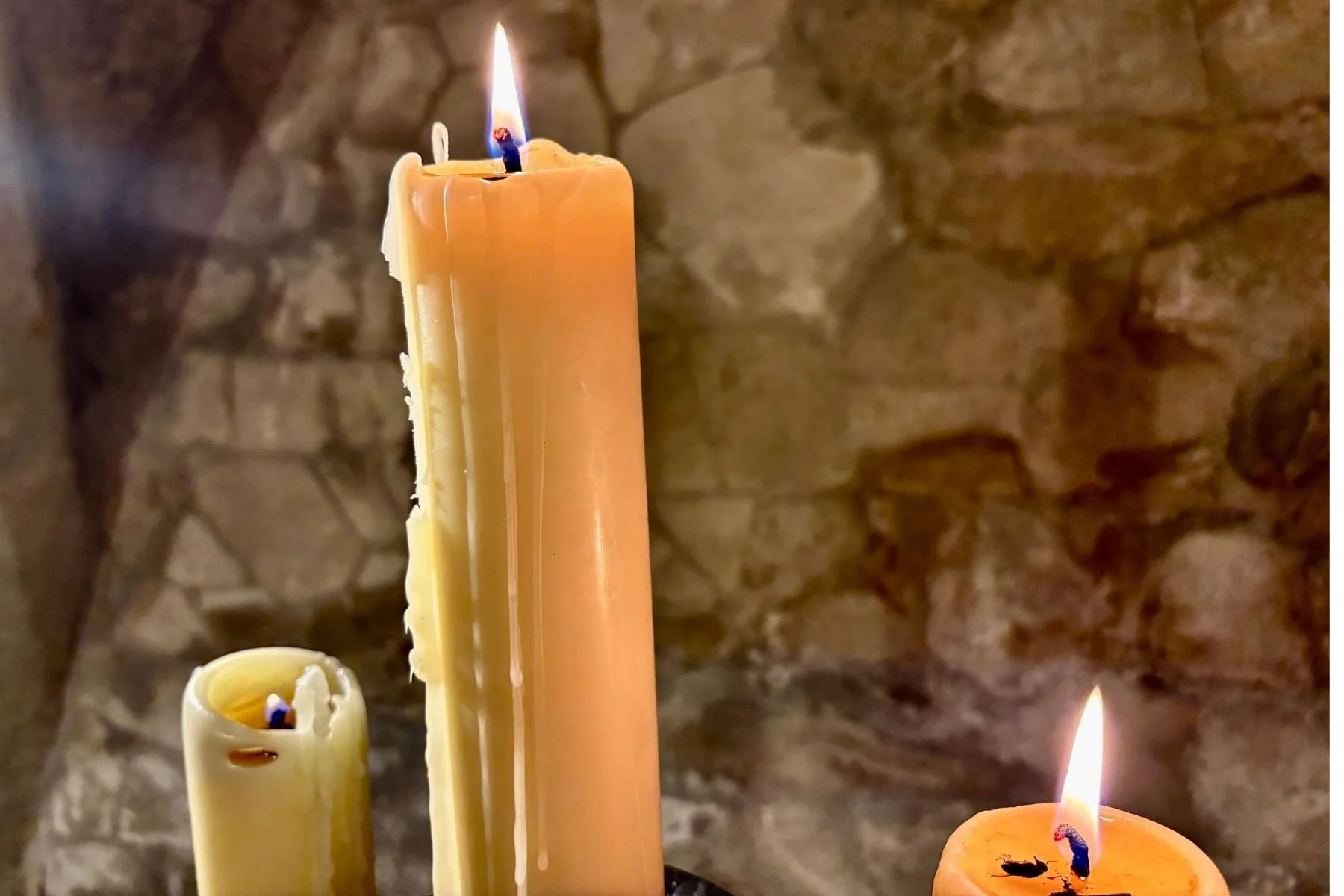
Candles in the Crypt of St Olave’s Hart Street.