
Well-sing:
Joining the Voices of Our Parish Wells
Deborah Colvin reflects on the upcoming ‘Ten Wells’ installation and its relationship to liturgy.
The Historic Wells in St James’s Parish
Early in the 20th century, there were 10 wells listed in St James’s area, all sunk during the previous hundred years. They are all Victorian wells with the exception of the one at Hatchett’s Hotel, a coaching stop on the route into London from the west, which was sunk in 1820 to offer hospitality to long-distance horses and ale-thirsty humans. You can see a diagram of our wells and more information on our Wellspring project page.
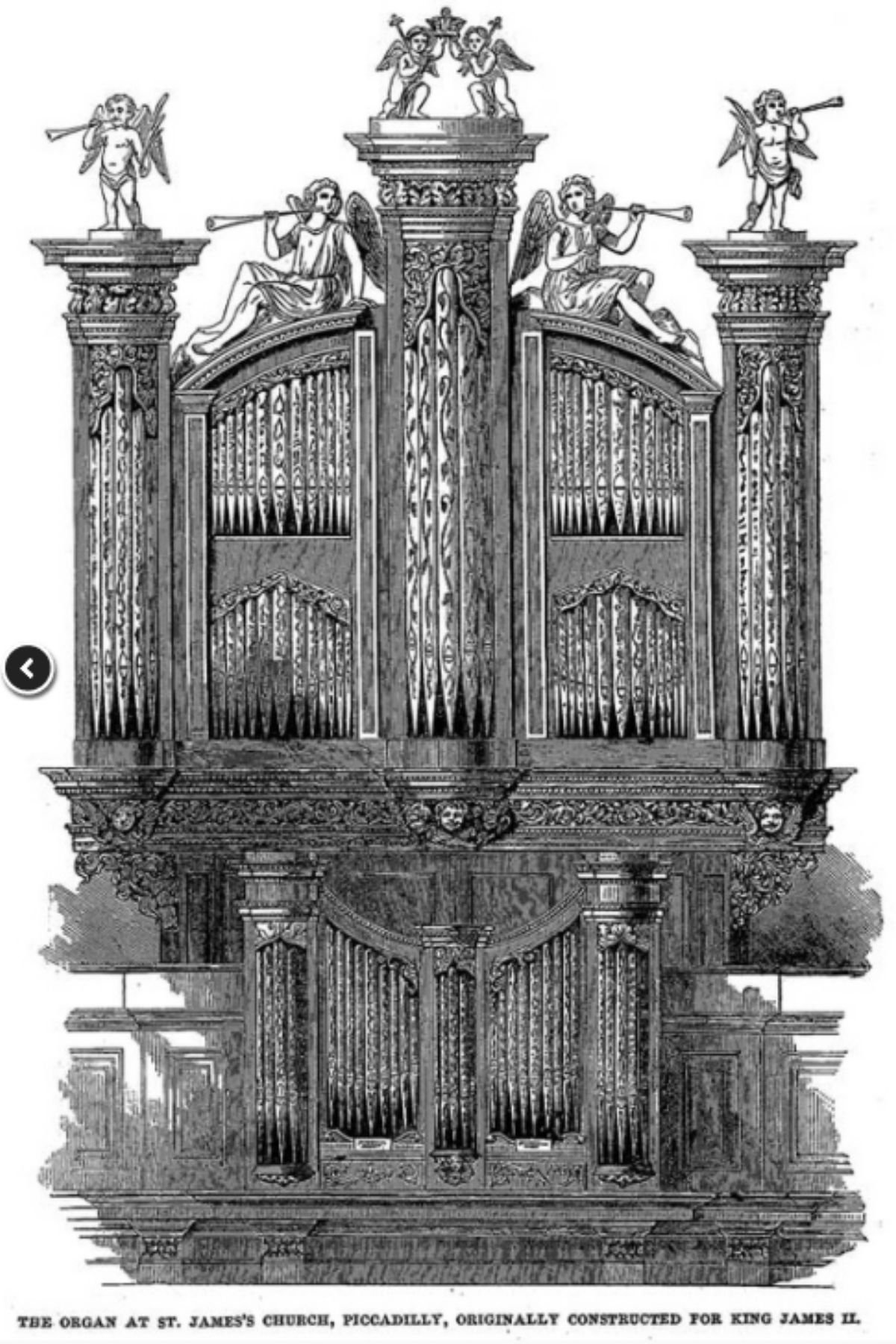
Renatus Harris organ at St James's, originally constructed for James II.

Trafalgar Square wellhead, London Evening News, 5 April 1845.
The ‘Records of London Wells’ in Memoirs of the Geological Survey published in 1913 is the reference point for our project. (1) This publication represents a moment in time when someone took an interest (it was commissioned by His Majesty’s Treasury). Attention was paid. A list was made. The sinkers-of-wells (usually private enterprise such as hotels) thought primarily about their own immediate needs. Geologists, engineers and the Treasury thought about the connections between things, recognising the wells as all coming from one source and aware that access to the source was not indefinitely guaranteed.
In the early 21st century, we are paying attention again. None of the wells themselves are still visible and we have no knowledge of their physical status under our streets. But their history and imprint remain and we celebrate the hidden connection they offer to the land-and-water-scape below us, tunnelling like reverse-periscopes through the geology. Perhaps they have collapsed and are full of sand and clay, perhaps they still contain columns of water as the water table rises again today, perhaps there are even tubes of decades-old air beneath our feet. We can speculate.
For example, if there is trapped air, could it tell us about changes in atmospheric composition over the last 100 years, the period of the Great Acceleration when carbon dioxide concentration has dramatically increased?
What if we were able to un-cap the wells? An un-capped well is effectively a tube, a pipe, closed at one end and open at the other. If air or water moves in a pipe – which is very likely to be happening in our wells as water tables rise and fall and the everyday business of millions of Londoners shakes the ground – then we have a musical instrument. The act of opening gives the wells a voice.
And not just any voice. Pipes have a speaking length and different voices depending on whether they are filled with air or water. The frequencies of sound (and therefore the pitch) produced by a pipe depend on its length and on temperature (because temperature affects the speed of vibrations in fluids). We know the depths (lengths) of our wells and the temperature underground is likely between 10 o C and 15 o C, so we can work out the fundamental frequency (pitch) of each well, and the associated harmonics which give an instrument its timbre. So each well has a characteristic chord, consisting of the fundamental and harmonics of a stopped pipe. (With thanks to Michael Haslam for conversation about this.)
Here is the formula:
Frequency = harmonic number x (speed of sound / 4 x length of pipe)
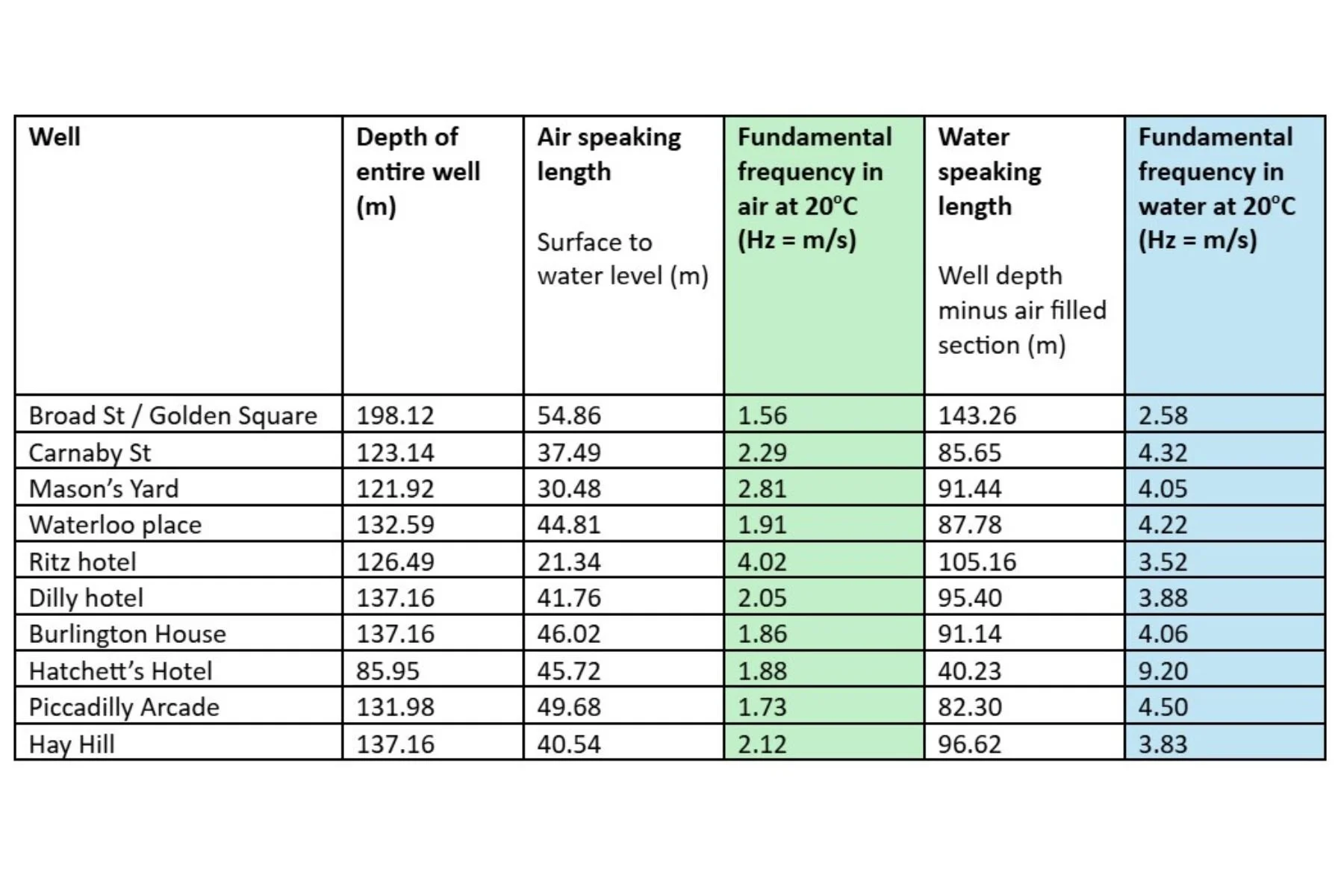
And here are some results for our wells:
Sound in air and water
The fundamental frequency (and hence pitch) is much higher in the water filled parts of each well. Vibrations travel faster in water than air because the molecules are jostling up against one another, rapidly passing on any news they receive. (The exception to this is the Ritz Hotel well which has a very long water-filled section compared to the air-space above it).
Creatures are finely attuned to collaborate with their medium, whether air or water. The song of a hump-backed whale is quite high-pitched (up to 31 000 Hz) and can travel thousands of miles across oceans. Meanwhile a blackbird energetically pushing waves of air outwards has a specialised organ (the syrinx) enabling it to play with air flow, and sings at a much lower 1500 – 8000 Hz
Human hearing and infra-sound
Human hearing range is typically 20 - 20 000 Hz so the wells are very low pitched for us because of their length - imagine a 130m long didgeridoo! We would not hear the wells’ fundamental frequencies with our ears, but maybe with our bodies? Can we practise attuning to vibrations that are outside our hearing range? Elephants detect ground vibrations with their feet, receiving information from other elephants hundreds of miles away. Those same whales generating high-pitched squeals also send out sub-sonic (to us) rumbles. Earth is pulsing with infrasound generated by surf, weather events, avalanches, earthquakes, waterfalls, lightning, calving of icebergs and more, and many creatures respond. In 2004 animals fled to high ground well before the Indian Ocean tsunami hit shorelines. Our wells speak the infrasound language of physicality and incarnation that so many creatures can detect.
Infrasonics is a whole area of human study. An early researcher (2) made an outsize organ pipe (an ‘infrasonic whistle’) capable of generating infrasonic vibration. Some singers can do this just with their voice. Dancing in front of a subwoofer can affect your heart. Many studies have associated infrasound with feelings of unease or spookiness, some report feelings of awe. Generally, there is little evidence that infra-sound causes harm to humans. As composer Sze Ying Chan points out, it’s loudness not frequency that causes harm – and if we can’t hear infra-sound then we don’t know how loud it is!
Audibility and music-making
Returning to a more usual understanding of what constitutes music for we humans, how can we bring ourselves into audible relations with the music of our wells? And from the perspective of the wells, can they ‘hear’ us in any kind of patterned way? Surely yes, because they respond to vibration in such an ordered way.
In addition to the fundamental frequencies in the table above, a ‘stopped pipe’ has many harmonics – higher and quieter tones which are integer multiples of the fundamental.(3) So by calculating these and making music with them we can have higher-pitched sound. The harmonics multiply up the pitch of the fundamental, allowing us to apprehend the physical vibrations with our ears, as harmonies. A transfiguration of physical vibrations into a register we can receive, by layering up and complexifying.
We could say that because we have ears and a brain, we actively participate in making sound audible, and the song that is made and heard is a collaboration. We are music-maker and audience – as are the wells? Organ pipes are commonly described as ‘speaking’, less so as ‘hearing’.
It’s interesting to think about this in relation to the refurbishment of St James’s organ. Michael talks about this on this video on the St James’s YouTube channel. What is happening in that workshop in the forest in Nottingham? How do you refurbish an organ pipe? Are all the pipes being re-used? Are some discarded? Are new ones added? What are they made of and why?
Liturgy: ‘joining in the worship of all creation’
Why does this collaborative composition exercise belong in a liturgy? There’s a lot to unpack here, and it’s easy to dismiss ‘joining in the worship of all creation’ as anthropomorphism, metaphor or colonisation. But it’s a persistent theme in faith and cultural traditions, and I would say an enormously life-giving one. An added layer here is that we are talking about wells which are not traditionally thought of as musical instruments, let alone other living beings!
Resources on this theme generally focus on we humans acknowledging other species doing their thing. Perhaps (for example) we project awe and delight (or urgent mating behaviour) onto birdsong. Meanwhile we humans get on with our important worship centrally, often with a sense of primacy, often with the rest of creation treated as backdrop or resource.
A simple variation to this approach is to slow down and wait. I have often noticed that after sitting for about 15-20 minutes the behaviour of birds (particular, individual birds) in my vicinity changes, perhaps with acceptance that I am joining in. This is much more noticeable in wilder places than in St James’s garden where the few resident birds are more habituated to humans. And there are so many more species to wait for! And so many beings we don’t generally think of as living.
A next step might be to focus on tuning (and attuning) ourselves to the possibility of encounter. More than just noticing, really listening to what the worship of the rest of creation really sounds like. St James’s eco-contemplative liturgies invite something of this approach. Waiting and listening over time, divesting ourselves of separateness, invites more and more of the bird-ness of birds to come into view, including (for example) their absolute integration into place and the community of species. Birds are not birds alone, birds manifest the whole wheeling planet, surging in praise.
If we are attuned to encounter, then we might be open to movement into I-thou relationship. 100 years ago Martin Buber published his influential book 'I and Thou' in which he describes how all of our relationships bring us ultimately into relationship with God, the eternal Thou. Buber describes ‘encounter’ as ‘entering into a relationship with the Other, participating in something with the Other, such that both the I and the Thou are transformed by the relation between them. The Thou is encountered in its entirety, not as a sum of its qualities; not as a point in space and time, but as if it were the entire universe, or as if the entire universe somehow existed through the Thou’. Tyson Yunkaporta (4) describes a form of Australian Aboriginal consciousness as ‘us-two’, which ‘conveys a way of thinking about speaker and listener, object and subject, giver and receiver — as two parties joining in a unified mind’ which seems to me to be in the same ballpark as I-Thou.
What kinds of things do we humans do liturgically? We come together, we sing, we open ourselves to otherness and what is beyond us, we empty ourselves, we join in, we harmonise (and bring dissonance), we keep silence. Perhaps we could learn to get out of the way and allow the same liturgical personhood to other-than-human species and the rest of creation. From a place of I-Thou or ‘us-two’ relationship, we might be able to make collaborative liturgy through encounter with creation-where-we-are.
What might the wells bring liturgically? A few thoughts to start with:
They bear information (in the expanded sense of the word that includes patterning, meaning and relationship) from that human-labelled place ‘rest of creation’. They speak through and of air and water and rock.
As entities, they offer encounter and relationship.
A well is a no-thing, an emptiness that allows itself to be filled with otherness. A vacuum and a plenitude, both, a kenotic space, an empty fullness.
Finally… the wells have their own voices, eternally making earth-symphonies. For us to hear them in our own register we need to engage, cooperate, contribute and collaborate. Unstop the wells and listen, then respond. We are not external observers, manipulators or makers of instruments in this liturgical space. We are collaborators and creatives, as are the wells.
Watch the Service on YouTube
A video of the full service can be viewed on YouTube on the link below.
References
A new edition of the ‘Records of London Wells’ was produced in 1938. It was called ‘The Water Supply of the County of London from Underground Sources’. Many more wells were sunk in the area in the 25 years between editions, and the approach to thinking about them had become more focussed on systemic issues. They will have affected our 10 wells.
Vladimir Gavreau – he and his research team were experiencing bouts of nausea in the large concrete building where they worked and eventually discovered it was due to a loose motor sending infrasonic vibration through the concrete. We are sensitive to vibrations outside the range of frequencies our ears are ‘designed’ to pick up.
There is some fun physics to do with wavelengths which explains this. For example https://splice.com/blog/what-are-harmonics/
‘Sand Talk’ Tyson Yunkaporta
Explore more from the Wellspring Project
Collaborate With Us
We're always open to new ideas and creative partnerships that bring multiple perspectives into focus in the service of Earth Justice. Please get in touch.
Explore Our Projects
Explore our evolving archive of multi-disciplinary, collaborative projects. We value art, poetry, science, faith, history, community engagement and more, and the creative spaces that open up between them.